Power or Authority? ©A.
Khoshkish |
 |
TABLE OF CONTENTS
|
PREFACE
The
antecedents of this inquiry go back to the late 1960's when a need was
felt to
examine power in itself in contrast to the then prevailing game theory
and
behavioral approaches to power (notably by Harsanyi, Dahl, March,
Gamson,
Bachrach and Baratz). The results of that study were presented to the
Midwest
Political Science Association in Chicago in 1971 under the title of
"The
Concept of Power: A Potentio‑Kinetic Approach". Many of the ideas
developed then have since become common concern in political philosophy
and
covered by many authors, permitting us to reevaluate and document
some of
those ideas.
But
the trend in the past two decades has become more and more normative
(Lukes,
Martin, Morriss, Isaac), ‑‑ some remaining descriptive (Nagel,
Oppenheim) ‑‑ with confining results. The reinjection of the
phenomenological dimension into the formal, descriptive and normative
treatments of power seemed again justifiable in order to keep our
perspectives
open.
The
results of the revisit to the topic were reported to the International
Political Science Association's Study Group on Political Power in
London in
1989. The present monograph is a reedited version of that report and is
prepared in proper printed form for the use
of colleagues and students who have expressed interest in our approach.
A
word on the "we" authorship of this monograph. A colleague inquired
whether it implied co‑authorship or, adding facetiously, it was the
royal
"we"! The answer was that it represented the traditional method
used
by authors who know that what they expound is the outcome of their
interaction
with their total environment. The alpha of this monograph's
authorship is lost
in time and space, somewhere between the Greek philosophers and the
legalists
of China, and its omega is Jacques Havet, respected friend and
colleague of
old, whose incisive comments on the last version of the manuscript
greatly
contributed to its improvement. To him and all go "our" thanks. But a
book is a living being. It communicates with the reader and the "we"
becomes the communion of the two. That communion is essential for our
understanding. Power cannot be grasped as a string of elements but as a
complex
of thought. At all moments of our discourse its whole is present. Yet,
because
of the limitations of the written word all does not exude at once. That
is the
handicap of the writer compared to a painter who can unveil the canvas
once
completed. The writer has to beg for patience for the ideas that are
yet to
come and remind the reader of the thoughts that have flown by.
The
more obvious factor of the total environment affecting our study
is, of
course, the literature quoted or listed in our selected bibliography.
While our
search and research have been greatly influenced by the works listed in
the
selected bibliography we have not always had the occasion to quote them
in the
text. The purpose of this short essay is not to review the
literature referred
to or mentioned in the bibliography. We have our own approach to deal
with and
assume that those who get involved are either familiar with the
literature or
our mention of it will whet their appetite to seek it.
Although
the tone and tenure of this monograph is academic, if the practitioners
of
power cared to plough through it, they may find it not without
practical
interest. Philosophical discourse on power can provide food for
thought for
fathers, corporate executives, presidents, governors, and dictators who
are
concerned about the control of their domains. Whether it is the
imperative of
shifting weight within their spheres of power to remain on top or the
need to
perceive and evaluate resistants within their power complex, they can
draw
inspiration from abstract concepts for developing concrete
strategies.
This
revision has been undertaken during a period ripe with significant
events, from
the advent of perestroika in the Soviet Union and the unification of
Germany,
to the crises in the Middle East. Where appropriate, we have used
historical
examples for our concepts. The temptation to illustrate them by current
events
was great and we indulged several times. But succumbing to that
temptation
altogether would have made us chase those events and never finish the
monograph. Rather, it would be more interesting for the readers to test
the
ideas developed in this essay against current events; whether it is, as
these
lines are being written, our concept of Domination Drive against Boris
Yeltsin's bent for leadership, our analysis of the Spheres of Power
against the
dynamics of glasnost and perestroika or the German unification, or
whatever the
phenomena of the time may be. The test will permit the reader to mend
and amend
whatever is lacking in our understanding of power.
A. Khoshkish
New York City, May
1991.
I
INTRODUCTION
There
was power long before there
was a written word for it.
Charles E. Merriam
This
is an inquiry into the phenomenon of power: An attempt to examine power
as it
is in itself.[1] As Merriam's words emphasize, power is not
confined to human terms of reference. In that spirit, we intend to
extend our
inquiry to the limits of our perception and yet recognize that
power cannot be
circumscribed within those limits. Thus, our approach will take us
beyond the
strict study of power within the human societal context. True, as Dahl
says, we
shall have our hands full if we confine our study to the power
relationship
between human beings.[2] But
keeping our hands full with the human
dimensions of power for too long may narrow our perspective. Indeed,
following
Dahl's advice, recent studies of power have focused on its social
aspects and
immersed it in normative systems and begun confusing it with
ideology and
authority.[3] Surely law, authority and normative systems
contain considerable elements of power and vice‑versa. But
confusing
them muddles the issue.
We
can better realize the dichotomy by moving to the confines of human
affairs. A
student of international relations, for example, is more sensitive to
the
phenomenon of power in itself beyond its convolution in normative
systems. From
an international perspective, normative systems, i.e.,
beliefs and ideologies, are more distinctly identifiable as
persuasion components for the legitimization of power within autonomous
complexes such as nations and states and are not confused with
power.[4] In the international arena, norms of
international law are often respected by powers which may not have
common value
systems. Beyond the two possible dimensions of conquest and defeat,
superior
and inferior, or power politics between entities which do not
recognize each
other's superiority or dominance and yet cannot overrun and absorb each
other,
powers create the third dimension of international norms to regulate
their
clashes and cooperation and to make the exercise of their power
reasonably
predictable.[5] "Raw" power eventually creates
norms and values for its own security and survival. But we are getting
ahead of
ourselves.
By
avoiding a total immersion in the societal context we may find premises
which
we could use to explain and overcome normative constraints.
Accordingly, while
perforce the thrust of our inquiry will also be human affairs, in
order not to
get too entangled in the ideological, legal and normative envelopes,
should our
analogies of social and natural phenomena coincide, in our search for
perspective,
we shall permit ourselves some digression. Our purpose in doing so will
be, to
borrow Bertrand Russell's words, "to suggest
and to illuminate, but not to demonstrate".[6] That may give our essay an
exotic
flavor. For that, we beg for the readers' forgiveness and appeal to
their
imagination.[7]
The
term entelechy in the title of this monograph has been borrowed from
the
Aristotelian theory of actualization of potentials.[8]
It has a dynamic and fermenting connotation. In strict physical terms,
potential is that which has not yet turned into kinetic energy, and
kinetic is that which by its motion has ceased
to be potential energy. The kinetic stopped in its course becomes the
potential
of its remaining energy. In other words, while on its course the
kinetic energy
carries with it the potentials of its continuity.
Potential
and kinetic energies are relative in their probability. Max Planck
always
remembered how his high school teacher Mr. Müller had told them
about the
conservation of energy:
"He
told us of the strength and power which a bricklayer needs
to lift
a huge stone to the roof of a building. The
energy is never lost. It remains stored up, possibly for years, latent
in the
block of stone ‑ until one day it is somehow loosened and, perhaps,
drops
on the head of some passerby ".[9]
Of
course the brick that is embedded in a solid wall, although a
potential head‑breaker,
presents less danger than a brick which sits precariously on the edge
of the
wall.
The
potentio‑kinetic concept hinges on convertibility. The potential side
of
the potentio‑kinetic concept of power corresponds to the Hobbesian
definition: "The Power of a Man,
(to take it Universally,) is his present means, to obtain some future
apparent
good".[10] But it is power insofar as the
relationship between the present means and the future good is a
dynamic,
materializable reality. This qualification of Hobbes' definition is
different
from Parsons' paraphrase to the effect that "‑‑ such
means constitute his (the Hobbesian Man's)
power, so far as these means are dependent on his relations to other
actor".[11] The two qualifications, the
dependence
of power on a relationship and its dynamic materialization, complement
each
other. It is in this existential and relational continuum that we
propose to
examine the concept of power.[12]
But
first let us see why and how man comes to perceive the phenomenon of
power. For
that we need to begin with the examination of the early
manifestations of the
phenomenon within the psyche and its role as the cue for the
identification of
the self in its total environment.
II
DOMINATION DRIVE
At the very beginning of its existence,
with its heavy brain and yet its weak body to carry it, the child
encounters
the realities of its contradictory being. Once out of the uterus it
finally
finds space to stretch and is, in a sense, freed from the confinement
of the
womb.[13] The fetus receives its oxygen, food and
warmth in the mother's womb, but is limited in its movements. Having
found
space at birth, the child soon experiences the discomfort of hunger,
and
changing temperature. It is at the
mercy of its parents' care for the satisfaction of its basic needs and
has to
submit to their rhythm. When it is hungry or uncomfortable, it cries.
Its crying,
which may be beneficial for its growth if the needs causing it were
satisfied
within reasonable biological limits, can turn into rage if frustrated.
Each of
these possibilities and the spectrum of other variations between
them will
have effects on the development of the individual's character and
personality.
Soon the individual becomes conscious of
his[14]
dependence on his parents.[15] His
dependence infringes upon his freedom
and imposes restrictions on him. At the same time he becomes habituated
to the
care he receives and develops an expectation for attention. The
degree of
attention received and expected will differ from family to family and
from
culture to culture. The child's expectation of attention goes
beyond the
satisfaction of his biological needs and relates to his needs for
affectional
relationships and contact comfort.[16]
This affectional attraction to the immediate environment, like the
attraction
for the satisfaction of biological needs, may meet a varying range of
responses. But even under the most favorable circumstances the
response cannot
provide total fulfillment for the affectional needs. To mention
but one
obstacle, the need for affection and attention and the response for its
fulfillment reside in different individuals. Even a dedicated and
loving mother
cannot meet her child's expectations of attention ex toto et
tempore, simply because expectations will evolve in relation to
their satiation.[17]
Thus the being, from the moment his
brain becomes capable of registering his experiences to the moment when
he becomes
conscious of himself as an individual, is constantly confronted with
situations
presenting limitations and possibilities. On the one hand they attract
him by
the security they offer; on the other hand they repulse him by the
dependence
they impose upon him. Attraction‑repulsion, love‑hate, and the
desire for freedom‑security are, psychologically speaking,
understandable
in their togetherness and mutual presence. It is the degree of
intensity of one
in relation to the other in a given situation that influences the
attitude of
the individual and makes him, for example, consider enclosure as
either
contributing to his security or confining his freedom. Thus, all
through life
man has to make choices between alternatives. By the very nature of
things he
cannot have his cake and eat it too.
As the individual goes through different
experiences in his life, first in his relations with his parents, then
with his
peers and his teachers, later with his colleagues and other members of
the
society, his dependence for security, freedom of action and
opportunities is
shifted to different sources. Of course, the optimum goal for him will
be the
possibility to control the sources on which he depends for his
security, thus
giving him freedom in their use and consequently "independence" from
them. In its more complex form security here includes not only the
fulfillment
of physiological needs but also the satisfaction of all of man's
drives, such
as affectional relationships which, while including the attention of
those who supply
him with his physiological needs, can also become more abstract and
cover such
expectations as recognition, admiration and respect. In other words,
all put
together the individual wants to be on top of the situation and
dominate it.
The child who cries for food to draw the attention of those who care
for him
and finally receives satisfaction, or who later charms his mother to
buy him
the candy he wants, already has some control over the sources of his
satisfaction.
The drive for domination, whether at the
level of child-parent relationships or in the arena of social and
political
struggle broadly follows the Darwinian law of the survival of the
fittest, or
in the present context, the dominant position of the fittest. The
domination
drive will, of course, be subject to other variables within the
social
complex. There will be neutralizing and propelling factors
influencing the
individual drives. The dominant position will not necessarily be
occupied by
those with the highest raw domination drive quotient, but by those who
reach
the power position in the flux of social dynamics and fermentations.
Thus, in
the omnipresent drive for domination, some will settle for more and
some will
have to, or simply will, settle for less. Those who do settle for less
extrinsically
(rather than going for the challenge of control and freedom of action)
have,
intrinsically (in their motivated behavior) opted for what they may
have
perceived as the path of least friction, or security provided for them
by the
powerful ‑‑ for fear of the unknown.[18]
In the evolution of a power
relationship, however, the dependence of those who have settled for
less on
those who dominate may eventually reduce the security the former
originally
sought. The goals of those who seek power for their own security and
freedom,
and who take control will not always coincide with the goals of those
whom they
dominate. In the extreme, the power-holders may develop a taste for
power as an
end in itself. It will be sought not only to provide security and
freedom, but
to give its holder the pleasure of overcoming resistance and making
others do
what they would not have done otherwise. Its exercise will be its
confirmation
and a source of satisfaction for other drives such as the drives for
excitement, game and challenge. Power may become engaged in a
spiral of
expansion.[19] Thus, depending on the circumstances, we
may detect different degrees of harmony, compliance, resistance
and conflict
in power relationships.
III
TYPES OF POWER RELATIONSHIPS
To
explore these variations, let us schematize a little.
Let A and B be power
complexes in a power
relationship.[20] Let us assume that when A wants B to act in a particular way (which we
will designate in each case as i', j',
k') it takes a particular action (which we will
designate in each
corresponding
case as i, j, k).
So, A performs i in order to make B
perform i'. Formally this is expressed
as (Ai |Bi' ). The two
variables
may combine in different ways, depending on the nature of the
relationship
between A and B and their actions, as
will be discussed in the following pages.
Under
different circumstances the combination may be that of simple
mathematical
operations of addition or subtraction, more complicated calculus of
vector
functions, or even scalar quantifications more appropriate for the
measurement
of mass and energy. The relationship will render a "product" which we
will designate a p; formally (Ai|Bi' ) → p. [21] The magnitude of p will, of
course, depend on the nature of the relationship and
interaction between A and B. The
power relationship in a power
complex matrix (which we will represent here for the power of A over B as P(A/B) may oscillate
between 1 and 0. That is
to say, A's power over B will tend
towards full power 1 when
every time A does i, j,
k, B does the corresponding i', j', k'. The power
of A
over B will tend towards 0 if every i,
j, k, action on
A's part encounters
noncompliance
or resistance on the part of B, which
we can represent as  . In between, where there
is both compliance
and resistance (as is usually the case), B’s
response will represent the net result depending on which is greater.
. In between, where there
is both compliance
and resistance (as is usually the case), B’s
response will represent the net result depending on which is greater.
CATATONIC POWER RELATIONSHIP
Let
us first conceive of an extreme situation where the dominated element
is
catatonic, i.e., it presents insignificant resistance. It complies
not because
it finds that compliance corresponds to its goal, but because it has no
vigor
for self‑actualization. In psychopathology, catatonic schizophrenia in
some cases refers to what is called waxy flexibility, where the patient
can be
molded into different postures by others and keeps those postures for a
long
time. In the catatonic situation,
illustrated in Figure 1, B’s resistance
to A's action i tends toward
0 and A's power over B approaches 1
– formally, Bi’ → 0 and P(A/B) → 1.[22]
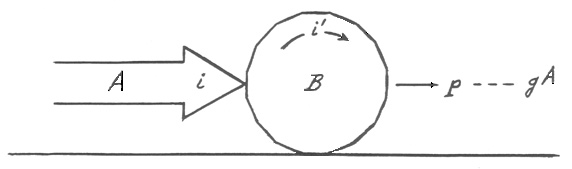
Figure
1
While A's power relationship with B approaches
the total unit, the
"product" of this power relationship may be 0 for A,
because the amount of resources A will have to
employ (which will be
identical with A's action i in the
catatonic situation) to make B perform i' may be nearly equal to i';
formally i'/i → 1, or i‑i' → 0.
Although
the product of the power relationship of A
and B may[23]
tend to zero, we may still consider A
as more powerful than B if the
proportion of A's total power
potentials to its action i is bigger than B's total potentials compared to its
action i'; formally, A/i >
B/i'. In the long run if A uses
a proportionally smaller amount
of its resources for actions i, j, k than
B does to perform its corresponding actions
i', j', k'
(assuming the same catatonic
relationship continues), A will not
simply maintain, but increase the ratio of its potentialities over B. This concept of proportionality will
be more obvious in the other kinds of relationships discussed later.
If B's resistance became zero, B would
cease as an independent power
and would be considered a component of A
‑‑ or its extension. The mention of this extreme, which can be
applied to human behavior only in rare psychopathological cases and,
with
qualification, to highly conditioned totemic subjects, calls for our
awareness
of such important characteristics of power as will and
consciousness. These
characteristics, which we shall discuss later, imply at this stage of
our study
that while B may be catatonic, A
should have a goal g in making B perform i'.
(Ai | Bi') will
render the product "p",
which may or may not be identical with A's
goal g. Also, p may or may not be
lucrative for A. As an illustration of the
non‑lucrative case, take the extreme
of power for the sake of power, which was mentioned earlier. Where A is a willful and conscious power, a
catatonic power relationship will not be much of a confirmation
for A's power and satisfaction, unless we
combine a megalomaniac with a schizophrenic. In that case, A's
exercise of power over B will
be like kicking stones on the road. In game theory language, our
catatonic
situation will approach the so‑called St. Petersburg Paradox, i.e., a
one‑person
game where one tosses a coin until he wins.[24]
If A's goal is lucrative, it is assumed
that in the catatonic situation the product, if any, will totally
accrue to A, formally (Ai | Bi') → pA. Of
course, we can conceive of a situation where A may
induce B to perform i' with part or
all of the product p
accruing to B. Take, for example, the case of the
catatonic schizophrenia given
as an illustration earlier. A may be
the doctor's power creating some will in B, in which
case because the result p
accrues to B, A will have less and
less of a catatonic relationship with B, and
their relationship may evolve into one of the other situations
described
below. If A's power over B is to continue in one way or another, the product of their
power
relationship
should be distributed so that a bigger part of it accrues to A's power potentials. For example, in
our last illustration,
while B gains more will‑power by the
doctor's Ai, he may at the same time
gain more conscious respect for the doctor's power. Thus, (Ai
|Bi’) → pA > pB.
COMMENSAL
POWER RELATIONSHIP
"Commensal"
was the term used by Hawley to indicate the relationship between like
species
in their parallel efforts to make similar demands on their environment.[25] Its literal meaning is: "eating from
the same table." In our concept of power, a commensal relationship
resembles Harsanyi's model where A
can make B move from an initial
strategy to a second one more favorable to A.[26] Here Harsanyi's assumptions are implied. Let
us say that landowner A does action i,
which in our model can include
canalization for irrigation and land improvement, favorable lease terms
(Harsanyi's reward), and competitive pressure (Harsanyi's threat) to
induce farmer B to leave his present low yield farm
(Harsanyi's strategy one) to come and farm on A's land
(Harsanyi's strategy two). B's coming onto A's
farm
is represented by i'.[27]
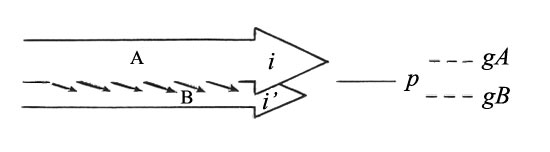
Figure
2
The
power relationship of the landowner and the farmer is commensal in that
they
have a common goal ‑‑ in the elementary sense, their need to eat.
Of course, the farmer B can farm his
low yield land and the landowner A
may have to farm his land himself instead of leasing it out. In such
case there
will be no commensal power relationship between A and B. There may be
other power relationships between the two which could fall into one of
the
categories that follow. By engaging in a commensal power
relationship they
increase their chances for a better crop (Figure 2).
The
product of their commensal power relationship may not be identical with
the
goals gA and gB which each of the
powers A
and B expect out of the relationship.
Landowner A may have planned on
benefits providing him funds for the expansion of the farm, while B may have counted on savings which
would enable him to procure a fertile farm of his own. Each one's goal
may
handicap the other and in their compromise they may not reach their
original
goals. The relationship may thus have, in Harsanyi's terms, utilities
and
disutilities for both partners and finally yield product p. Of course,
the
power relationship is commensal in so far as A and B have the primary
common goal of nourishing themselves. The more there are interests in
their
individual goals which are not compatible with those of the other, the
more our
model will tend to approach the divergent or conflicting power
relationships
explained below.
*
* *
Before
proceeding to other categories of power relationships, let us
retain some
aspects of this second model which will be useful for our later
discussions. In
general, as a result of A's action i,
B
will perform i'. Notice, however,
that landowner A's action i included
not only reward and threat
directly addressed to B, but also
land improvement and irrigation canalization, which are for A's
general welfare too. One might say
that these last items are independent of the power complex under
consideration. But they surely did influence B's evaluation and final
movement towards performing i'.
Let
us make the point by another illustration. Suppose A
is an excellent marksman and while he is performing i,
that is, is target shooting, he is
observed by B. Now, suppose he asks B to perform i' and B,
having been impressed by A's marksmanship
and assuming the
threat of A's gun, complies. Yet, A
may be a peaceful character who loves
target shooting as a sport but would not think of using his gun on a
living
being.[28] We will leave B's subjective
evaluation of A's
intentions and A's consciousness of
his power for a later stage of our discussion. At present what is to be
retained is that A's action i which
made B do i' was not directed
to B. Of course, a range of
situations may be conceived where A
may do i partly addressed to B and
partly for other purposes. A may have been shooting in
our example
not only for practice and fun, but also to impress B.
A military parade is simultaneously a festivity and a
demonstration of force to evoke pride in the citizens, to assure the
allies and
to threaten the enemies.
While
the consideration of all of Ai will
be useful for the understanding of B's subjective
evaluation of its power relationship with A,
only that part of i which has been exerted or spent by A directly to bring about Bi’ should be
taken into account for the assessment of A's
costs. This cost, as we said earlier, can include
expenses
other than direct reward and threat addressed to B.[29] We can represent this cost by is and
complement the formula presented in the case of a catatonic power
relationship
accordingly:
i' >
ic , A/ic >
B/i', p > O, (Ai | Bi') →
pA → pB
This,
of course, is a clear‑cut and straight‑forward potentio‑kinetic
power position for A. Because A's cost
is less than B's efforts, the proportion of A's cost to its resources is smaller
than that of the ratio between B's efforts
and resources, and a bigger portion of the end product accrues to A. Situations may arise, however, where
one or more of the favorable conditions may not exist and yet A may still be considered to have power
over B. Take for example the case
where A may have had costs greater
than B's efforts, or the ratio of A's costs
and resources was smaller than
that of B's, but that the amount of p
accrued to A was of such a magnitude that it
compensated for the other
unfavorable conditions. Or take the case where the ratio of A's costs
and
resources was so insignificant that although a bigger part of the
product
accrued to B, all in all A came out
of the deal more powerful.
Although, as we shall see later in our discussion of the nature of
product
"p", whether p corresponds to the goal
pursued by A and is compatible with it is crucial
in the determination of the outcome in the power complex.
It
should be noted that the difference between the catatonic relationship
and the
commensal (and those following) is that in the former no distinction
was made
between i and ic. The
rationale is that if B is catatonic,
it
perceives only A's action directed to
it and therefore,
for A, i is equal to ic.
Further, it may be
proposed that if a distinction is made between A's
action i and its cost ic
toward the A/B power
relationship, then B's action i'
should also be distinguished from its cost. The proposition
would make the distinction between action
and cost obsolete if it were applied
to both sides. The distinction in the case of A and
not in the case of B is
justified, because in our conceptualization Bi' is
only that action of B
which is directly and totally involved in the power complex, while Ai may also be involved in other
situations. Actions of B not related
to the particular A/B power
relationship are not counted in the equation in order to reflect a
clear power
situation. Of course, power situations are multi‑directional, and
we
will need to repeat our computations for each direction and
combine them for a
more complete picture. Formally, we may then combine the different
variables
into:
(i'+ A/ic + pA)
> (ic +
B/i'+pB) → P (A/B)
This
formula is not an all‑encompassing quantification for power, but is an
attempt at encapsulating the variables conducive to a power
relationship.[30]
It also applies to our discussion of power relationships that follows.
While by
attributing comparable units to their components we may use our formula
to
measure specific and confined power relationships, the intangible
dimensions of
power impede its general quantification. Our further discussions will
show, for
example, that under certain circumstances the interactions,
transactions and
reactions of the components of a power complex may follow more the
laws of
direct and inverse proportionality than simple operations of addition,
subtraction, multiplication and division.
SYMBIOTIC POWER RELATIONSHIP
Symbiosis
here means interdependence and specialized coaction, involving some
degree of
mutuality between organisms of different kinds.[31] Defining symbiosis, Clements points out the
large and wide use of the term and adds that the mutuality of the
coaction can
fluctuate greatly from type to type. In our terminology "different
kinds" do not necessarily imply totally unlike species. Two countries
with
different resources, or two parties with different ideologies, may
become
involved in a symbiotic relationship. In our model for power, a
symbiotic
relationship is different from a commensal one in that it is not a
simple
association.
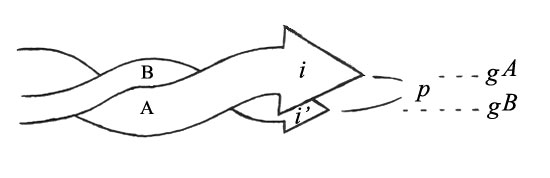
Figure
3
In
a symbiotic relationship as distinct from commensal, each of the
components A and B of the power
complex can move toward its goal only with the
participation of the other. The difference can be demonstrated if
we take our
last example of landowner and farmer and turn it into a
feudal‑vassal
relationship where the feudal prince is not much of a farmer and the
vassal
cannot have access to farmland without taking an oath of allegiance to
the
feudal prince for the land and his protection.
To
illustrate further, we may say that a commander without an army or an
army
without a commander makes little sense. Another example is the
negotiations
between the oil‑producing countries and oil companies.[32] The industrial societies of Western Europe
and Japan cannot function without the oil flowing from the countries of
the
Near and Middle East. Inversely, the oil‑producing countries need the
oil
revenues which subsidize their budgets and finance their economic
development
and military ambitions.
The
symbiotic model best illustrates the potentio‑kinetic continuum and can
be said to be most recurrent in power complexes, because the components
of a
power complex will usually combine, although the result will not be
equally
beneficial to the components involved. The bacterium may kill the
legume in the
long run.
DIVERGENT POWER RELATIONSHIP
Here
we are presented with a model where the goals of A and
B do not coincide.
Or let us say, the model is for that part of A's and B's goals which
do not coincide, because divergent power relationships may coexist with
other
models. By divergence we imply that the interests of A
and B under
consideration are not on a collision course ‑‑ we are leaving that
for our next model.
Suppose B is a butterfly collector who
has
travelled to the American Midwest to pursue his hobby; but, influenced
by A who is a geologist, B helps him
prospect for mineral
deposits. B is obviously not doing
what he originally wanted to do. A
may eventually establish a mineral chart of the area. B may
also succeed in interesting A in butterflies and make
him spend some time running after them.
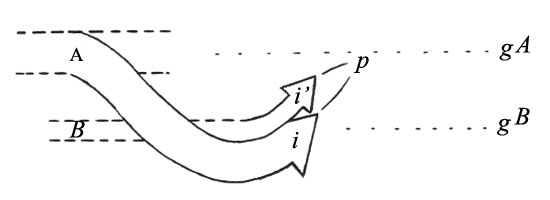
Figure
4
The
more the vector of product p
approaches gA, the more we can say
that A has power over B and the
more p will accrue to A.
CONFLICTING POWER RELATIONSHIP
This
is what in game theory language corresponds to a zero‑sum game. It is
the
extreme of opposing interests. What A
wins, B loses, and is not willing to
lose.
The
likelihood that B will resist the
exertion of power by A will be great
and Aic may consist mainly
of threat directed at B. There will
also be a considerable amount of [B ],
or a tendency to non‑compliance on the part of B, which
will have to be taken into
consideration in the evaluation of Bi’.
],
or a tendency to non‑compliance on the part of B, which
will have to be taken into
consideration in the evaluation of Bi’.
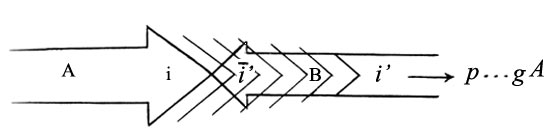
Figure
5
There
are, of course, variations to the conflicting situations. A and B may be after the
same indivisible goal and their clash may be competitive like that of
two
football teams. Or A may have designs
to dispossess B of some of its
sources of power, like two countries at war over a territorial dispute.
Our
earlier models can turn into or involve conflicting dimensions. This
may be the
case, for example in the commensal situation of landowner A
and farmer B, or their
parallel version of feudal‑vassal in the divergent model. If A goes for total submission of B in
order to expand his land, or if B exploits A's land
for quick profit
with a view to wresting it out of A's
hands, resulting in the erosion of the land, A
and B will clash in
their conflicting interests. For the symbiotic model the extreme of the
predator and the prey relationship turns, of course, into an obvious
conflict
of interests.[33]
In
the conflicting situation ‑ more than in other models ‑the
probability will exist that after a power confrontation there will
remain a
contestant to the product. The product accruing to A
may have been a former possession of B. Of course, the
outcome of the conflict may have been the total
annihilation of one of the contestants, or, total absorption of
one by the
other: The product may have been B
itself; an outcome which calls for a better understanding of the
product.
IV
THE NATURE OF THE PRODUCT
OF POWER RELATIONSHIPS
Figuratively
speaking, the chunk that A bites off B
should be digestible. The presentation pA indicated
the feedback of the
power relationship's product into A's
circuit. In absolute terms, not only should it be more substantial than
the
cost A has incurred (pA > ic), but it should be compatible with A's resources and other power
potentials. It should become part of A.
PRODUCT‑COST
REPLENISHMENT FUNCTIONS
The
problem that arises is that of the product‑cost replenishment
relationship. The product may indeed be more important than the
cost incurred,
but it may be alien to A's organism
or require a slow digestive process. Were the acquisition of the Grand
Duchy of
Warsaw by Russia at the Vienna Congress, or the occupation of
Yugoslavia by
Germany in World War II, desirable products of a power relationship? It
was
Bismarck's awareness of this problem which made him adopt a diplomacy
of peace
in Europe after the Franco‑Prussian War in order to let time work for
the
cohesive assimilation of the components in the newly born German Empire.[34]
There
may also exist a catch in the ratio between the cost and the product.
True, the
power relationship can be considered positive and rewarding for A when pA > ic.
But by how much? A power which uses a great quantity of its cognate
resources
to acquire a substantial quantity of an alien material may find its
cohesion and
composition weakened. To keep in line with previous examples, recall
the case
of the heterogeneous Austro‑Hungarian Empire and its fate.
Thus
in our potentio‑kinetic evaluation of power we have to take into
account:
(a) the compatibility of the nature of the product of a power
relationship with
the nature of the powers it will be absorbed by,[35]
and (b), depending on the consequences of (a), the ratio between the
cost and
the product. The measurement of this ratio is subject to the nature of
the
product for the obvious reason that the more the product is compatible
with the
nature of the receiving power the easier it can replenish the
cost. These two
dimensions imply (c) which would represent the rate of absorption of p into the potentials of the receiving
power and its rate of convertibility into kinetic power. This last
point also
covers the more general question of convertibility of the potential
resources
as a whole into kinetic energy: How readily liquid and ready to be
activated
are a power's potentials?[36]
POTENTIO‑KINETIC
CONVERTIBILITY
Beside
the product accruing to a power as a result of its transactions, its
own
cognate resources each have different degrees of convertibility. A
country may
have vast iron and coal resources, but may not have industrial and
manpower
capacities to turn those resources into machinery and weapons. What we
are
considering is the relationship between A
as the total power potential and Ai
as its kinetic action. Let us go back to Max Planck's stone on the
wall.
Standing atop the building, A can
threaten B underneath that he will
throw on him the massive stone if he does not comply with A's
command. The stone, according to the laws of gravity, has
indeed the potential of falling. But, if it were solidly and heavily
cemented
to the building, while we may calculate its potential according to
physical
laws by multiplying its weight and its distance from the ground, it
does not
constitute a power potential for A
because he can not turn it into kinetic power; and B, aware
of this fact, will not be impressed by his threat.[37]
Now, suppose the stone in question is not solidly cemented, that A has a lever at his disposal which
could topple the stone, and that B's possible
movements underneath are
limited. The potential fall of the stone is a threat to B if
he does not comply with A's
command.
In
this situation A's superiority over B is
his position and the means which he
can turn at will from potential into kinetic. A is
powerful because he can make B feel his threat,
making the latter comply with his demands
without having to topple the stone. As long as this situation prevails,
A keeps his power over B. What
if A did topple the stone?
The
moment the stone starts its free fall may seem the zenith of exertion
of power
by A over B. But it is also the
moment when A ceases to have control over the means of
its power. If the stone
does not hit B, the power of A over B will be exhausted. If the stone does hit and crush B, with the elimination of B the power
situation will altogether
cease to exist (assuming, of course, that A
was limited by the elements under consideration). The situation evokes
Mao
Zedong's famous thought to the effect that “political
power grows out of the barrel of a gun “[38]
which, in the light of our illustration, should be qualified by de
Madariaga's
lines: “The gun that does not shoot is
more eloquent than the gun that has to shoot and above all than the gun
which
has shot”.[39]
If A had a way of replacing the stone or
lifting it back before it hit B, we
would then need to reevaluate the different situations.
Now
suppose that next to B are C, D, E,...in situations similar to B, having
limited possibilities of
movement and threatened by toppling stones from A's
position (and A has
more stones ‑‑ President Reagan invaded Grenada and bombed Libya
and had more ships, planes and missiles). While the isolated power
relationship
between A and B will have ceased on
the crushing of B by A's stone, the
event
may now be added to A's power
potential in relation to C, D, E ...
n who, having witnessed the course of events,
will be more clear
about A's intentions. In this
hypothesis A may have lost one power
relationship but may have enhanced his reputation in relation to others.
Although
our examples may have helped illustrate the kinetic concept of power,
the
addition of just one more dimension will show the complexity of power
relationships and the difficulty to establish quantitative and
mechanical
patterns for them. Take, for example, a case in which the sight of B being crushed aroused A's religious
and moral convictions and
he renounced using his possibilities further. Not only will he no
longer be in
a power situation, but those under his control may ascend to his
position and
take over; that is, as soon as A's
new dispositions have shown exterior signs. The injection of religious
and
moral convictions into the equations of power, however, moves us
towards
restraints and constraints imposed on power by a value system
which, as we
shall discuss in chapter IX, if shared by those submitting to
power, could
serve for the legitimization of power into authority.
V
SOURCES OF POWER
Our discussion of the convertibility of potential power into kinetic has led us into yet other dimensions of our topic.[40] We are no longer talking about bricks and guns as sources of power, nor cement as a handicap to the use of power. We say that by throwing the first stone A could create a new dimension for his power ‑ his stone throwing reputation with C, D, E, ...n. But his crushing of B could also create religious remorse in him, in many ways a bigger handicap than the cement of the wall. Of course, the action could also have had an inverse effect and removed his inhibitions about killing. The control to which we referred earlier, which the child exercises through his charm to get the candy, is obviously not based on physical force but is already a more complex phenomenon containing the ingredients of power.
As pointed out earlier, we are making a distinction between power and the normative, legal and authoritative systems. At the same time we will include in this section some, and in the section on spheres of power other, hues of a spectrum which recent analyses of power have broadly established as follows [41]:
Means – Domain – Scope
–
Extension – Reliability – Strength – Cost
(Bases)
(Range) (Amount)
Incidentally, the reader will notice that what was attempted
so far was
a feed‑back process to link the two sides of this spectrum.
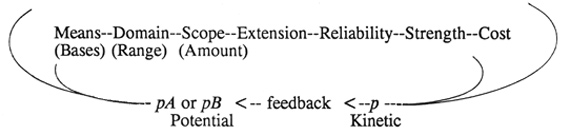
The dimensions of power need closer examination.
BRUTE
FORCE
Brute
force can, of course, give its holder the possibility of control. It
lasts as
long as it is forcefully superior. But its very simplicity and
directness makes
it vulnerable and breakable. Naked force can be easily evaluated and
analyzed.
It is like a piece of stone; it holds only by its weight and rigidity;
when it
hits other rigid phenomena weaker than itself, it breaks them; when it
encounters superior force, it breaks. It can only be a part of the more
complex
and flexible phenomenon of power and should not be confused with it.
We
need to add here a note on terminology -- Keeping in
mind endnote 8,
Chapter 1. In our dissection of power we are giving
strict connotations to terms which in a broader sense can each be used
as
synonyms of power. Furthermore, it should be kept in mind that terms
carry with
them cultural, linguistic and ideological biases. In linguistic terms,
some
languages provide more or less flexibility for dealing with the concept
of
power. For example, the French language distinguishes between puissance and pouvoir. The first
closer to force and strength but not quite
synonymous with them ‑‑ as the French language has also the term force. Puissance is a more palpable
concept of power.[42]
It is used,
for example, to identify foreign powers: les
puissances étrangères ‑‑ those powers whose presence
is felt at
the border. The term is also used for energy such as electric power. Pouvoir has a more complex connotation
and is more easily convoluted with authority.[43] Pouvoir – as
distinct from its Latin origin potestas – is both a noun and
a verb. It is a doing power. In German, Macht, which
stands for power, has a dynamic significance and is
related to action
through the verb machen. In English, Macht
turned into might and potestas and pouvoir turned into power. Both without a verb. Power is
not
something you can do; it is something to have and to be.[44]
In
our comparison of power and brute force, we could say that power has
the
potentialities of adaptation, resistance and pressure. In its encounter
with a
superior but simpler force it does not break, it can contract or
retreat and
withhold its potentialities without being irremediably crushed or
broken. When
in a favorable position, it can put on the rigidity of steel and give
its
adversary the fatal blow. It is the phenomenon which has retracted, yet
has
kept its potentialities and can make its pressure felt. The phenomenon
that has
been squeezed and takes its new squeezed shape without potentialities
of
pressure is not, in our analogy of power, a rubber ball or a spring. It
is a
piece of dough! Power is by its potentiokinetic presence.
Churchill, speaking
of the movements of the German battleship Tirpitz towards the P.O.
17 convoy
to Soviet Union in the Arctic in W.W.II, noted: “The
potential threat which they created had caused the scattering of
the convoy. Thus their mere presence in these waters had directly
contributed
to a remarkable success for them.”[45]
In
human terms, within the spectrum of brute force we can identify
physical force
(muscular) at one extreme, and certain aspects of stubbornness,
fanaticism and
determination ‑‑ individual or collective ‑‑ at the
other extreme. These latter intangible factors are included within the
concept
of brute force because when certain character traits such as
stubbornness or
fanaticism reach the point of rigidified behavioral patterns they
become
comparable to brute force. The propulsion they produce is forceful and
yet, in
its rigidity and directness, vulnerable and breakable.
Take,
for example, the character traits of Ayatollah Khomeyni of Iran in the
1980's.
In the Iran‑Iraq war of 1980‑1988, with dogged stubbornness he
mobilized his fanatical troops to withstand the shock of Iraqi attack.
Yet,
when there came the opportunity in July 1987 – when Iran had the
upper hand
and Saddam Hussein had accepted the United Nations cease‑fire
resolution
– Khomeyni was not flexible enough to take advantage of it. While the
situation
involved more complex power components which we shall develop later,
the case
in point here is that Khomeyni's vengeful stubbornness was a
factor in the
continuation of the fighting to the detriment of Iran.
Of
course, as it is for other sources of power, the evaluation of
brute force is
subjective and its outcome relative. .Within the power complex, the
assumption
is that if B submits to A's forcible
command it is because B finds submitting to A more agreeable than the consequences
of A's coercive punishment. The
assumption is subject to B's perception
of pain and pleasure and his relationship with A. A
masochist perceives pain differently from a paranoid.
MEANS
The
means at a power's disposal are obviously of great importance. By means
we
refer to a spectrum extending from primary tools and weapons, which are
nearer
to the force end of the spectrum such as a stick, to more subtle means
such as
money and wealth. We are using the term "means" in its stricter sense
‑‑ close to its material and instrumental characteristics.[46] The term "means" can, of course,
be given a broad connotation, particularly in the combination of
means and
ends, as done, for example, by Hobbes, mentioned earlier.[47] In that context, some have even gone so far
as to emphasize the preponderance of means over the ends. In the words
of
Gandhi: "They say 'means are after
all means'. I would say 'means are after all everything'. As the means
so the
end. There is no wall of separation between means and end. Indeed the
Creator
has given us control (and that, too, very limited) over means, none
over the
end. Realization of the goal is in exact proportion to that of the
means. This
is a proposition that admits of no exception"..[48] It is, of course, a question of semantics
and what we want the term to cover. Gandhi is using the term "means"
in a much broader sense than our meaning. As we noted in our discussion
of
force in the last section, terms can be given different connotations.
In the
broader sense, means can be used as a synonym for power; in particular
when
coupled with ends. What Gandhi says is that one needs power to achieve
one's
goals.
When
used in that broader sense, the coupling of means and ends raises
significant
philosophical debate in different cultural and ideological contexts.
The
question becomes that of the justification of power's
arbitrariness on its
course to attain a given goal. Such are, for example, the exercises of
power by
revolutionary regimes. That the doings of power have to be justified
implies
the presence of a value system to which the power claims or wishes to
adhere.
Thus, the dictatorship of the proletariat, whose goal is the
emancipation of
the workers and the establishment of human rights, may exploit the
workers and
oppress the people on its way to achieve the ultimate goal. Of course,
a power
which does not submit to a value system and does not aspire to
justification and
legitimized recognition is free from the means/ends constraints.[49]
Our
narrower usage of the term "means" here – limiting its connotation
to instrumental and material sources of power -- permits us to
dissect the
components of power more closely and better analyze their areas of
overlap.
POSITION
The
position from which power is exercised is another crucial factor. The
illustration given earlier of A atop
the wall is at the primitive end of the spectrum. Let us use that
example here
to make a first assessment of the three different components singled
out so
far. A was in a favorable position
atop the wall, his means were the stone and the lever, and he should
have had
the force to move them. As in the case of force and means, position can
cover a
spectrum going from the simple instance of a strategically favorable
location
to complex social situations.[50] The
president of a bank, the governor of a
state, the justice of the peace, each holds a position conducive to
power.
However, the aspect of the position we are considering here is not
totally
identical with what in those titles coincides with authority. What
we are
presently considering is neither an office, nor exactly the right to
the power
that it legitimizes.[51]
It is the power potential that a position can provide beyond the
framework of
its formal authority. Chamberlin, Churchill, Macmillan, and
Thatcher were all
British Prime Ministers. Of course, they exercised their authority
under
different circumstances and conjunctures. But it would be
unreasonable to deny
that, abstraction made of the circumstances and conjunctures, the kind
and
quality of the power each wielded was different.
A
bank president has the authority to sign the grant of loans. But he
does that
mostly on the advice of his experts. In performing that function
he may not be
doing more than a post office clerk who has the authority to notarize
signatures. Beyond that simple signature, however, the bank president
holds a
position which can radiate power. That depends very much on the person
and the
use he makes of the other sources at his disposal to wield power by
exploiting
his position. The bank president who exercises his duties strictly for
the
management of the bank and does not have a power base – inside and
outside the bank
‑‑ which inclines him to favor one direction as distinct from
another, is not using his position for those particular power ends.
Indeed, if
he does not, he may not last long in his position unless he is there to
buffer
contending powers.
CONNECTION
This
dynamic concept of position leads us to further sources of power. A
power may
tap its connections with other powers ‑ not only vertically, but also
laterally and diagonally to strengthen its own resources. Power A may call on power C for help in the A/B power relationship and return help
to C in another context. The lateral
connection between powers in the fluid area between their
complexes implies
that they perceive mutual benefit and compatibility and convergence in
their
interests as compared to other combinations:  The imperative of
connection leads powers to networking. In our earlier
classification of power
relationships we did not include a convergent power relationship.
Because
convergence, to the extent that it is lateral connection, while
creating a
"relationship", does not necessarily create a "power
relationship". As the fluid area between power complexes that have
lateral
connections is filled by their respective expansions, the lateral
connections
may evolve into diagonal relationships which could be symbiotic or
commensal
and eventually turn into a hierarchy. In that sense connection and
contact
are, as we shall see later, sine qua non components
of power which, besides being relational, is also hierarchical.
The imperative of
connection leads powers to networking. In our earlier
classification of power
relationships we did not include a convergent power relationship.
Because
convergence, to the extent that it is lateral connection, while
creating a
"relationship", does not necessarily create a "power
relationship". As the fluid area between power complexes that have
lateral
connections is filled by their respective expansions, the lateral
connections
may evolve into diagonal relationships which could be symbiotic or
commensal
and eventually turn into a hierarchy. In that sense connection and
contact
are, as we shall see later, sine qua non components
of power which, besides being relational, is also hierarchical.
According
to Parsons, "While the structure of
economic power is... lineally quantitative, simply a matter of more
and less,
that of political power is hierarchical; that is, of higher and
lower levels.
The greater power is power over the lesser, not merely more
power than the lesser. "[52] Of course, this qualification implies
comparability.
Without relationship and connection, it is not realistic to compare the
power
of a Soviet farm cooperative manager in Siberia with those of the
Sheikh of Ras
el Kheyma, a banker in London or a Medellin drug baron. Even where
indirect
relations exist but direct connections have not been established, one
relational situation may not imply another. For instance, it does not
necessarily follow that because A is
more powerful than B, and B is more
powerful than C, A
is more powerful that C. The nature
of the relationships may not be comparable, and as long as they are not
connected in a power relationship ‑‑ whether by the intermediary of B or otherwise ‑‑ we
cannot say that A has power over C.
The AB relationship may, for example, be professional,
while the B/C relationship may be paternal or
conjugal.
The
assumption, however, is that where power relations exist, hierarchical
imperatives arise. Even the lateral mutual help connection will not
always
remain on a par and will be subject to the interplay of the whole
potentials of
the components.
POWER
OF PERSUASION AND INFLUENCE
Carrying on with
connection, to
secure C's cooperation, A may need to
persuade C that the product of their mutual
assistance will benefit both of them. If A
has a good power of persuasion he may draw a picture showing all the
advantages
to C, although, in fact, in the long
run the outcome may be more profitable to A.
This eventuality brings us to the power of persuasion as yet another
source of
power. Persuading B to do i' in a
vertical power relationship is
also one of the possibilities for A
instead of using his force or material means. Depending on its
magnitude,
sphere and duration, persuasion could serve as one of the factors for
the
legitimization of power into authority, which we shall discuss later.
To
persuade implies the capacity to influence or to have influence. Of
course, the
simple fact of having influence may not involve a power relationship.
To
illustrate our point, suppose you told your friend in a restaurant that
a
certain stock was likely to rise on the market, and someone next to
your table
overheard your conversation and as a result bought that stock ‑‑
something he would not have done otherwise. You have influenced him but
you
have not consciously exerted power upon him. Like other ingredients of
power,
only that part of influence which connects effectively will be part of
a power
complex.
Note
our specification of influence as one of the ingredients of power
and distinct
from it.[53]
The gradation from "having an influence on”[54] to "having control over"[55]
can be established in the potentio‑kinetic sense. The effect of A's action on B may be the creation of
a disposition, or rather predisposition,
for a changed behavior in the future.[56] B
may not have complied the first time, but if he did the next time it
may be
because the leftover of A's last
influence magnified the influence exerted upon him this time. That is, B would not have complied with A's
desire or command this time if the
last event had not taken place.
We
may equally conceive of situations where the earlier influence may have
an
adverse effect on attempts at later control. Take for instance the
guilt
complex inculcated by the parents into a child against stealing and
that
child's inhibition to do so when asked by his parents in a desperate
survival
situation. We can extend that analogy to the consequences of unfair
treatment
of an adversary's population in a conflict by a nation upholding
humanitarian
principles ‑‑ the case in point is the public and media outcry in
the United States against the use of "Agent Orange" in Vietnam.
The
potentio‑kinetic concept implies, of course, that the earlier influence
and later control should be part of a continuum within a given power
complex.
If gang‑leader A's threats do not induce member B to
obey but create enough predisposition in him to obey later as
a soldier faced with a superior threat from sergeant C, B's
obedience to C should not be counted as the power of A over B.
B's inner disposition,
however, is a
factor that should be taken into account. We are thus recognizing the
inner and
outer properties of certain sources of power. It is in the
fermentations and
dynamics of the power complex that the internal properties of its
components
become effective. The external manifestations, however, become part of
the
power complex insofar as they correspond to an inner reality. That
reality may
or may not correspond to the external manifestations, i. e., looking
tough and
in reality being tough or, as we shall see later, being aware of its
own
exterior manifestations by the entity emitting it.
SELF‑CONFIDENCE,
CHARISMA AND REPUTATION
The influence exerted
on the eavesdropper in our earlier example in the restaurant may have
been due
to a confident tone. In other words, the apparent self‑confidence of
the
person making the statement. Here we are speaking of the external
appearance of
self‑confidence which may involve no power control. In a power
continuum,
as mentioned above, it should be coupled with consciousness.
In the long run, apparent self‑confidence
can remain a component of power if it reflects inner self‑confidence
and
to the extent the person emitting it is conscious of it. This
latter
prerequisite has a reality of its own independent of the former; i.e.,
a person
who has little inner self‑confidence may be conscious of the fact that
because
of some elements of his exterior appearance and personality, such as
charisma,
he radiates self‑confidence, or he may discover that certain behaviors
or
attitudes indicate self‑confidence and may adopt them. These are, of
course, components of consciousness which we shall deal with shortly.
Here,
however, the point should be made that "acting" self‑confident
develops into a tool for attaining other components of power: For
example, in
certain contexts – such as is often the case in the United States – one
of the
crucial criteria in the selection of decision‑makers is the
demonstration
of the capacity to make quick decisions. When a decision is called for,
the
clever aspirant to power takes the initiative of taking the decision –
whether
he has sufficient reasons for doing it or not ‑‑ and distinguishes
himself as a leader and a quick decision‑maker. Keeping ahead of his
mistakes – where he has erred – he may thus advance on the social
ladder and
acquire other sources of power.
Apparent
self‑confidence can thus be counted as a source of power. Its impact
becomes evident when it is combined with other ingredients: force,
means and
position used with selfconfidence; and self‑confidence as a
dimension of
influence and the persuasive process. Charisma, mentioned in that
context, may
be a characteristic in its own right. But it is seldom separable from
the power
of persuasion and self‑confidence. It may, of course, happen that a
charismatic person is not necessarily self‑confident, or that he
inspires
rather than persuades.
Back
in the restaurant, we may find that the eavesdropper is influenced
by the
speaker's reputation. He may be influenced even by the reputation of
the
restaurant! Suppose he is an amateur investor having lunch in a
restaurant near
Wall Street known for being the rendez‑vous of financial experts.
Taking
his neighbor at the next table, who behaves like a habitu6 of the
restaurant,
for a stock exchange expert he may be impressed by what he overhears
and act
upon it.
Reputation
can be produced by other components of power. Consider the
possibilities of
combining means (money and mass media) with persuasive techniques
(contents of
mass media programs based on social psychology) and through publicity
and
propaganda creating a given power image. Reputation, however, implies a
time‑space
continuum. In just about all human cultures, and even among some
animals,[57]
pedigree can serve as a source of power. It is the reputation the
holder has
inherited that produces the image. Where the name is known, a
Rothschild is
assumed rich until proven otherwise.
But
above all, reputation is
the manifestation of the potentio‑kinetic nature of power. It is a
present dimension of power, based on the experience of its past
behavior, plus
the potentials available to it for future action. The hords of
Jenghiz Khan
became invincible as their reputation preceded them.
CONSCIOUSNESS
AND
WILL
In
the human context, all this, of course, implies knowledge and
know‑how which, beyond implying specialized
skills, should include the general
capacity to analyze, to evaluate, and to draw appropriate conclusions
for
action ‑ including timing, improvisation as well as organization and
planning.[58] It is this capacity that can establish
the relative value of the components of power, even the intangible ones
such as
self‑confidence and reputation. A power can combine and exploit
its
potentials to extents which may exceed the possibilities of any one of
the
components in isolation. Its potentials include its awareness of
external
manifestations of its properties not corresponding to its inner
realities, and
its capacity to use them, in other words, bluff.
Courage and risk‑taking are
components of power. In its analysis of possibilities, a power should
relate
its power position to other power complexes in the context of
total
environment. When Churchill asked his chiefs of staff on British
preparedness
to face the Germans, they replied:
"Our
conclusion is that prima facie Germany has most of the cards;
but the
real test is whether the morale of our fighting personnel and civil
population
will counterbalance the numerical and material advantages which Germany
enjoys.
We believe it will.”[59]
Later events proved
them right.
The
knowledge factor is so important that it has become the subject of
simplification for those who are in search of power but are incapable
of
essentially absorbing it. Knowledge has thus been reduced to
information.
"Information is power," so the saying goes. But information is only a
tool of power which enhances power insofar as a power knows how to
use it.
Francis Bacon, that old hand at using different variations of power,
had said nam et ipsa scientia potestas est.[60] Information is a most important tool for
power. But if the capacity to use it is not present, information will
be a
computer ticking in the desert.
Power
does not imply that the powerful "possesses" all the sources of
power. Knowledge means knowledge about the availability of the sources
of power
and the capacity of combining and using them. Where A
wants B to do something
that it would not have otherwise done, and where C has
strong and agile muscles and D has a club, A can exert
power over B if it persuades D to
give the club to C and C to hold the
club over B's head
so that the latter complies with the wishes of A. A, for all that matters, may
be a midget.
The
analytical and evaluative capacities of a power then cover not only the
consideration of its own relationship with another power, but also the
analysis
and evaluation of the conflicting natures of other powers or simply
different
textures and shades of those powers in their relationships. Thus one
power
complex may use other powers against each other or combine some of them
against
some others in situations beneficial to itself. Great Britain remained
a great
power through the 18th and 19th centuries partly because she
successfully
played this balancing game in the European power complex.[61]
Parenthetically
it should be emphasized that while cognition, consciousness, will,
knowledge
and the capacity to manipulate information have been enumerated as
components
of power, wisdom and sagacity have not been included as its sine
qua non characteristics. While
intelligence and cognitive elements of wisdom can be used for power
ends,
wisdom and sagacity in themselves may not aspire to power. Indeed,
history is
fraught with powerful wisdom midgets.
Our
parenthetical remark leads us to two "factors" of social power,
namely, competition and ambition. They
are not sources of power
but rather propulsing factors for the realization of power. They are
social
manifestations of the will to power and domination drive discussed
earlier and
account for the existence of powerful wisdom midgets. History is
lamentably
short of philosopher kings. What it is rich in are ambitious, shrewd
operators
manipulating the sources of power to get on top of the heap; modelling
themselves after The Prince of
Machiavelli rather than taking inspiration from the Meditations
of Marcus Aurelius. These
factors translate into such social theories as the
survival of the
fittest, and the selfish interest motives of capitalism, and are social
realities reflected in processes of legitimization of power into
authority
which we shall touch upon later. In the democratic process, for
example, the
operators get the money from the rich (notably through contributions to
the
candidate's party or campaign funds), use it to impress the people
through the
media, get support through a give‑and‑take network of other
operators and potential cronies, and finally the votes of the
multitude. They
then project an image of wit and intelligence by employing
speech‑writers
and devise their strategies and policies by picking the brains of the
intellectuals. In different systems it turns into the manipulation of
the
apparatus by operators and apparatchiks, producing
representatives, senators
and presidents. Of course, what interests us more here is their will to
power
and their consciousness about the ways to get it rather than the
authority attributes
of their position.[62]
The
relationship between the will to power and the ways for its attainment
is
crucial for the understanding of the entelechy of power. The saying:
"Where there is a will, there is a way" is true insofar as the two
propositions are connected, i.e., the
person who wills power knows the way and engages in it. The case which
best
illustrates our point is probably that of Nietzsche, the philosopher
of the "will to power".[63] Conscious
and cognizant of his own will to
power, Nietzsche, who longed for audience and disciples, did not know
how, or
disdained, to engage in the processes and compromises which would
have make
him powerful.[64]
The will we
are referring to as a crucial source of power is will‑power rather than
a
will to power. It is neither a schopenhaueresque incessant impulse of
the will
to live, nor Nietzsche's entire instinctive life. While it addresses
human
cravings, will‑power itself is not craving; it is determined and
is
capable to exert power. It is the characteristic which, conscious of
the
sources of power, turns them into power. In social terms, in the
particular
case of Nietzsche, the potential power of his philosophy of the will to
power
was exploited by his sister. Through organization and exploitation of
other
sources of power – hers and her brother's position, connection,
influence,
reputation and knowledge ‑‑ Elisabeth Förster-Nietzsche
actualized
the potential power of Nietzsche's philosophy into audiences and
disciples
which Nietzsche had so much longed for.[65]
In
our review of the sources of power we have gradually moved from the
more
elemental to the more cognizant. As a simple illustration, one may say
that the
water behind a dam is only force. Before the dam was built, the
downhill flow
of water was brute force rolling boulders down the mountain. After the
dam is
built, it becomes tamed force with potentials to generate electric
power. But
no power will be produced if the valves of the dam are not opened and
the water
is not permitted to become active by
its movement. If there were no turbines and generators behind the
valves, the
movement of water would simply turn into forceful streams. It is in its
contact with the turbines and generators
– which put up a relative resistance but rotate under the pressure of
the forceful
stream – that the water becomes effective in
generating power. The power‑holders, however, are those
who create
the incremental potential by holding
the water behind the dam and put it in contact with the generator and
decide on
the distribution of electricity. The power they control is the
potential energy
which the high level of water holds behind the dam. Power
can thus be conceptualized as the conscious incremental potential
of an actor who is active, in contact and effective.[66]
The consciousness of power may remain at
the stage of knowledge, i.e., as a potential source of power. In our
earlier example
of marksman A, it would correspond to
a situation where A is aware that his marksmanship has
impressed B, but does not exploit it to establish
a power relationship. In our potentio‑kinetic conceptual framework, for
A's consciousness to become a positive
element of his kinetic power, the existing power relationship must have
been
brought about by A's intention and will.
Of
course, A's will in its net form is
aimed at gA originally set as A's
goal. The product of the power relationship
may not, as we saw earlier coincide with A's
goal. The discrepancy between gA and p
may be due to factors beyond A's control. The more A is conscious, in the potential sense,
of the factors beyond its control which may affect his power
relationship, the
more he will adjust his will, in the kinetic sense, such that gA will be near to p. What is implicated
here is the subjectivity of both
consciousness and will and their relevance in the potentio‑kinetic
spectrum. The factors beyond A's
control include the consciousness and will of those upon whom A wills to exercise power. Those
consciousnesses and wills are in turn subjective variables with
different
degrees of flexibility. Beyond the circumstances and conjunctures which
are not
controllable by powers involved, the product of their power
relationship will
depend on the interplay of their capacities to analyze, evaluate and
draw
appropriate conclusions for action – and their potentials to adapt to
and
absorb the consequences of one action in order to move on to subsequent
actions.
VI
COEFFICIENTS OF POWER
Subjectivity
of analysis and evaluation on the part of powers involved, discussed in
the
last chapter, may also bring about a product which may be more
favorable than
the goal fixed by a given power. Suppose, for example, that in B's consciousness, A's intentions of
reprisal are exaggerated. Moved by what,
according to Brentano, "is the subject's relationship to a content, or
the
direction of an object (which need not be the reality)" B accomplishes
an act beyond A's expectations.[67] The discrepancy between A's
intentions and B's “Vorstellung” [68] of them may be due to B's misperception
‑or knowledge ‑‑ about a degree of A's
capacities, of which A may not be
conscious. While the
product of the power relationship accrued to A
may have been greater than the goal fixed by A because
of the above discrepancy, the cause of the discrepancy
itself, i.e., A's additional
"capacity", cannot be considered as A's power
potential unless A
becomes conscious of it and takes advantage of it. The discrepancy as a
potential may go wasted until A or B or
a third party C becomes conscious of it and uses it as
a source power.
The
case may best be demonstrated by its extension ad absurdum
to the total non‑existence of A. If A exists only in B's frame
of mind ‑‑ a
proposition advanced by Nagel and picked up by Dahl[69]
‑‑ can we objectively say that A
has power? In the imaginary world of B there
exists the phenomenon A which we
should take into account when we analyze B's behavior.
As A does not exist in
reality, we should see where the spoils of B's
behavior in relation to the imaginary A
end up. Nagel's example of the Japanese surrender because of the fear
of more
atomic bombs does not accrue to nonexistent bombs but to the U.S.
The
beneficiaries of the Vorstellung of
the totem, god, goddess or Santa Claus[70]
are the temple priests and other social relationships.
Granted,
this is a strict empirical approach. As much as the follower of the
particular
god or goddess may not be able to substantiate its existence, we
will not
necessarily be able to prove its non‑existence. The fact, however, is
that existing or not, the thing or non‑thing has manifest power. Many
authors have pointed out the magic dimension of power.[71] This non‑existential dimension as a
source of power entangles us with "power‑in‑itself". The
subjective psychological dispositions do not seem to provide all the
answers.
The voodoo death or
physical
disorder may be explained as a psychosomatic reaction of the subject to
a
taboo.[72] But the taboo does not cease after its
effect is produced. It is rather enhanced. The definitions given by
Codrington
of mana and quoted by Durkheim can
bring some light to our discussion: "There
is a belief in a force altogether distinct from physical power, which
acts in
all ways for good and evil; and which it is of the greatest advantage
to
possess or control. This is Mana….. It
is a power or influence, not physical and in a way supernatural; but it
shows
itself in physical force, or in any kind of power or excellence which a
man
possesses. This mana is not fixed in anything, and can be conveyed in
almost
anything”.[73]
In
existential sense, skeptical but cognizant of this subliminal and
sublime
"power‑in‑itself" at the empirically "nonexistential"
state (a contradiction in terms), we may have to conceive of a
coefficient to
the sources and resources of power. The assumption being that the
whole may be
more than the sum of its parts. Thus, simple additions and
multiplications of
different sources of power may not give us a whole picture of power. A
parallel
can be found in nuclear physics. The weight of an atom is less than the
weight
of the protons and neutrons comprising it. The weight discrepancy
is
compensated by a relatively enormous amount of energy within the atom.[74] Where are we to look for the coefficient of
power? The Bergsonian elan vital did
not apply only to groups, armies, societies and what we know as living
beings.
Bergson compared the power of human mind to the potential energy
stored in an
atom.
The
coefficient of power in socio‑political terms turns into what we may
call
the "engrossment factor" ‑‑
feedback which engrosses power. Engrossment does to human relations
what a
laser does to photons and a transistor does to electrons. Like photons
and
electrons it should be measurable. The problem is that it is lodged
within
humans; hard to measure. But just because it cannot be measured, we
cannot
discarded it. Discarding it would be like ceasing to observe, in
order to
understand, the universe, because we cannot count the stars.
Engrossment
factor was the charge and the goose bumps which the intonation of Sieg Heil in the Nuremberg rallies
created in those who shouted it and the elation it produced in the Nazi
party
leaders on the podium who felt engrossed to go onto grosser deeds. Or,
replace
the elements in the equation with the mollahs and the masses
shouting
"Down with America" in the Iran of 1980's. Surely, there is
acquiescence in the assembled masses in these examples which is the
authority
attribute of the power holders.[75]
After all, the German people voted the Nazis into the Reichstag through
free
elections, and the mollahs are legitimized by the power of Allah. But
there is
also a charge which is different from that of a sedate assembly
listening to a
reasonable and calm politician. The charge goes beyond Le Bon's mental
unity of
the crowd and their collective mind.[76] It is a controlled and organized charge for
the engrossment of power. The crowd, compared to a controlled and
organized
mass, is what a flashlight is to a laser. Hitler was quite
conscious of those
properties. To turn the photons of the flashlight into the deadly rays
of a
laser, to convert the individual Vorstellung potentials
into the engrossment factor, to transform the
energy of the
masses into a coherent tool for power, Hitler observed:
“The receptivity of
the great masses is very limited, their intelligence
is small, but their power of forgetting
is enormous. In
consequence of these facts, all effective propaganda must be limited to
a very
few points and must harp on these in slogans until the last member of
the
public understands what you want him to understand by your slogan.”[77]
In interpersonal
relations, the
coefficient of power is the boss's feeling of omnipotence after denying
promotion to a subordinate, not because of his lack of
qualification, but
because he was irreverent in his behavior towards the boss ‑‑ that
is, to the extent the boss senses his power in doing so and does not
feel
remorse or doubt for his action. The coefficient of power is also what
in the
relationship of the boss with another subordinate, whom he has
promoted, turns
into respective feelings of magnanimity and loyalty.
Magnanimity and loyalty
are terms conveying power and its dynamics. They are power
attributes which transcend and, from within, corrode law and authority.
The
magnanimous leader, king or president, pardons the convict. A loyal
servant
does not denounce his master who may have committed an unlawful act.
The
subordinate covers up the boss's mischiefs. Loyalty has the
primitive and anti‑social
in it. It has the elements of charisma, influence and persuasion on the
one
hand; and belonging, security, looking‑uptoism and fear on the
other hand.
It is what holds the bands of pirates and the gangs of Los Angeles and
New York
together.
Decatur's ". . .our country, right or
wrong" had some of it. While nationality is a legal concept based
on
the norms of international law, nationalism is imbued with
loyalty. While
nationality provides for rights and responsibilities, nationalism
generates
pride and sacrifice and serves as the coefficient of the power of a
nation. It
is what, beyond the need for security and greed, adventure and
curiosity, made Western
powers become great in the 19th and 20th centuries. It is the component
which,
together with industry and balance of payments made Japan a power in
the latter
part of the 20th century. Collectively, the coefficient is esprit
de corps. The consciousness of power is not exactly that of
the rational man. One could say that if one has never felt power, one
would not
be able to understand the proposition. But then, everybody has.
Merriam,
approaching the concept of power as an element of balance and
equilibrium for
social situations, shows, in his chapter on the Family of Power, the
omnipresence of power as the dimension of any group ‑ whether a state
or
a band of pirates.[78] If we
generalize the term "group"
to encompass not only human or animal groups, but any group which has a
cohesion, we may come close to the atomic illustration and conclude
that the
cohesion of the group, be it an atom, a tree, a group or a
constellation
implies the existence of power. Without it no group structure or
movement can be
conceived.
Viewed
thus, power, being the prime mover, could be sought and maintained for
its own
sake. Many schools of thought, from the legalist philosophers of China
to the
political thinkers of modern Europe, have pleaded the case of power.[79] Power‑in‑itself,
however, cannot exist in itself as an essence. It is power, as we saw
earlier,
in so far as it is in contact, active and effective. Even the
"non‑existent"
taboo, mana or the totemic principle is to the extent of its
effectiveness and
impact over its subjects. Power is not loose and total freedom. That
would
equate to total absence of power. Power is not freedom; it is by the
degree of
its freedom of action over its sphere
of power. A look at the spheres of power may help us examine further
the existential
conditions of power.
SPHERES OF POWER[80]
To be active, in contact and effective,
power must mesh with the elements which it has or wants to have power
over. In
the process of entanglement to gain power, those who seek dominant
positions
may confine their freedom. Power has been generally likened to a
pyramid
because at every stage of the struggle for domination only some of
those at the
bottom will move up, and by the very nature of the situation dominate
those who
remain in the lower strata. The repetition of the process results in a
pyramidal shape and by definition, a pyramid has a wide base and is
narrow at
the top.
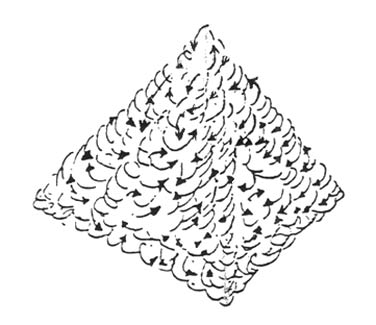
Figure 6
But the pyramid of power in not a static
geometric form. Its dynamics and fermentations require permanent
exercise and
affirmation of the power which shapes it. Within it, there will be
constant
contacts, interactions, transactions, and counteractions among
complexes which
make it a whole. (Figure 6).
Power, if it is power, is ever evolving.
It is for the sake of simplicity of presentation that at this stage we
have
pictured it as a plain pyramid. Like all other socio‑political
phenomena,
power should not be visualized as a hard piece of concrete, but as a
flux in
which every particle is an interacting factor in the whole.
Figuratively, in
its dynamics and fermentations, a power complex, like a viscous
crystal, should
be able to go from extreme rigidity to the near weightlessness of
alight gas.
Within any relationship there is an optimum stage between rigidity and
weightlessness where power, depending on its texture, can function
best. At the
rigid extreme it may exercise brute force ‑‑ an effective
instrument under certain conditions ‑‑ while under other
circumstances it may diffuse and lighten its pressure over its
components or
opponents so that its weight may scarcely be felt, and yet it may
remain in
control.
The top of the pyramid sits best, of
course, when it distributes weight evenly over the base. In
political terms,
this happens when power exercises equal control and/or care over
different components
of its complex. Depending on its fluidity, it may have a greater or
lesser
freedom of action when it shifts its control and/or care within a
tolerable
radius.
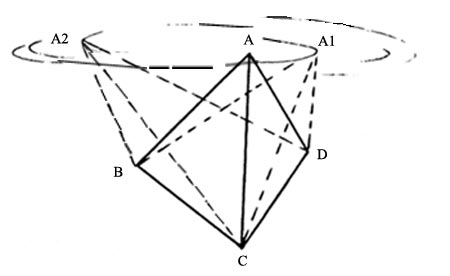
Figure 7
In position A1 in Figure 7, the top of
the pyramid is distanced from points B and C of the base and other points along the connecting lines
AI B and Al C as compared to
the A1 D line. A1 either controls
the A1D area
of the pyramid more or gives it
more attention and/or care. Yet it seems still to be in balance,
because in
its overall situation, its relation to D compensates
its distance from B and C. In
position A2 the power holder seems to be in a more
precarious situation. It
is off‑balance and may fall. The shifting of control and emphasis by
the
summit of the pyramid is, of course, an involved process within the
different
strata of the complex.
The points of pressure and support may
not be identical and uniform from top to bottom. Each point of control
within
the complex may have a greater or lesser radius of oscillation,
depending on
its viscosity. There are, within the complex, "proximate policy
makers".[81]
(Figure 8).
Figure 8
In a corporation, union, political party,
or Mafia, we could focus on a sector such as ABCDEF in
Figure 8 for closer scrutiny and examine its relationship
with other sectors and the whole. We may find that in its immediate
environment
it has a better (or worse) reputation, or is (or is not) solidly
controlled.
Recognizing and conditioning the domination drives of different
components of
a power complex and accommodating within it the resistants ‑‑
which we will discuss in the next chapter ‑‑ are essential for the
control and exercise of superior and encompassing power. Evaluation of
degrees
of control possible, their loci and their nature will be crucial for
the
efficiency of a power complex. The conqueror king, in order to
rule a larger
territory, may have to divide the conquered land among his lieutenants;
the
professional association, in order to accommodate a large number
of members
subdivides into specialized groups providing multiple turfs. The
diffusion
may dilute the encompassing power but may also serve as its means for
better
control. Providing the components that have their own spheres of
identity with
prerogatives of inclusion and exclusion will develop illusory or real
power
which they would want to guard against each other, creating the need
for the
encompassing power's arbitration. Divide and rule is a precept for
power. Those
who exercise or are delegated to exercise power at different
levels and
sectors of the pyramid thus share, drain or enhance the power of the
summit and
the whole.[82]
Power has the possibility not only to
oscillate within a radius on a plane as in Figure 7, but also to
compress or
dilate, thus condensing or rarefying relationships among its components
(see
Figure 9).
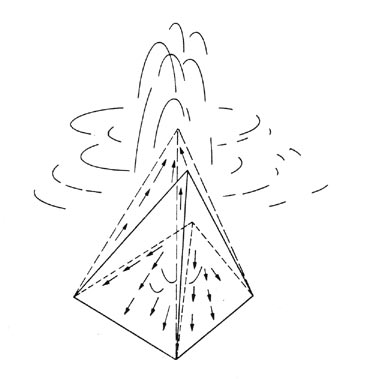
Figure 9
Power may compress when it needs better
control of a situation or when the components require closer
relationship in
order to give better cohesion to the whole. The compression may take
place also
at the base and the power‑holder may, or may have to, relinquish
grounds
in order to keep the same angle of power within remaining components;
otherwise, a compression from the top, without reducing the expanse of
the
bottom, will flatten power-holder's controlling position. (Figure
10).
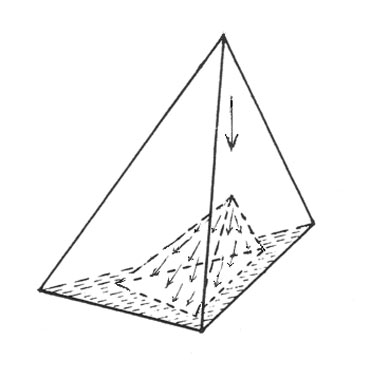
Figure 10
Flattening implies reduction of power
components, such as a reverse process in a cumulative economy which, if
continued to the extreme, could revert to a subsistence level where
there would
be few ingredients for building a substantial power pyramid.[83] The model applies to a variety of instances
such as the retreat and regrouping of an army, the retrenchment of a
business,
or reduction in the international commitments of a nation.
On the other hand, a power may initiate dilation when a condensation within the complex calls for easing of controls. It may also be a prelude to an elation of power strata preparing for further expansion. (Figure11).
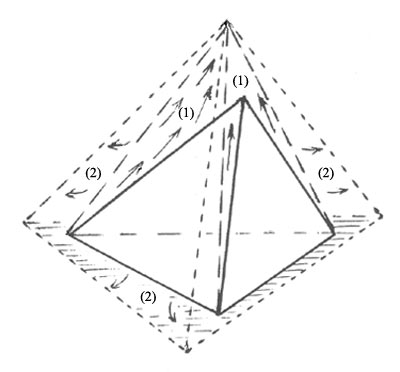
Figure 11
But an elation without possibilities for
expansion at the base, distancing the upper strata of the power complex
from
the base, may reduce its stability. For example, in the complex French
politics
of the 1960's, de Gaulle envisioned a superpower foreign policy which
many of
his countrymen, more concerned with crucial domestic problems, did not
share
with him. His posture gave an impression of aloofness resulting in the
dissatisfaction and alienation of some of his popular base and
culminating in
the 1968 events and the uprising of the students and workers' strikes.[84]
Shifts, compressions or dilations of
power create different relationships and ratios within the power
complex,
upsetting the prevailing habits, frustrations and expectations, and
perhaps
eventually changing its nature and course. A party leadership
which starts
shifting to an emphasis on workers' rights will eventually embrace more
of the
ideologies of trade unionism and socialism than those of free
enterprise. The
shift may take place because of a prior trade unionist penetration into
the
leadership of the party. (Figure 12)
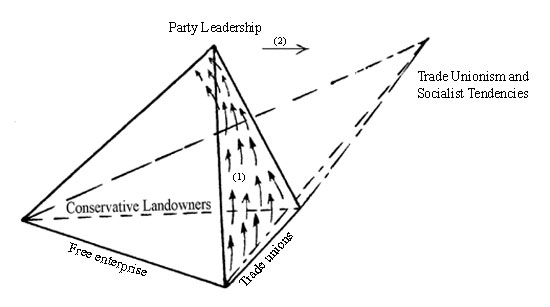
Figure 12
Or it may be caused by policy‑makers
who, although not of trade unionist origin themselves, may have
detected
favorable grounds among the workers. In the latter case, if the shift
persists,
the party's rank‑and‑file may gradually be penetrated by trade
unionist elements. (Figure 13).
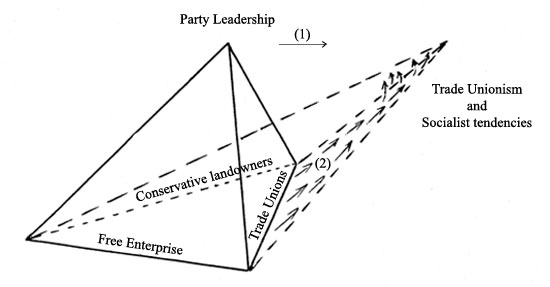
Figure 13
In general terms, growing emphasis on the
role of certain sectors of the power complex may amount to the
passage of some
power potentials to those sectors ‑‑ a trend which may not be
reversible and which may eventually change the power relationship
patterns or
even the nature of the power complex. A father who permits his son
to use the
family car, both to make the son more useful in doing family errands
and to
give his son more liberties, will have less control over the car than
before.
It will be difficult to revert to the earlier situation and prohibit
the son's
use of the family car without compensation or friction. Similarly, the
industrialist who, after having run his enterprise on the basis of his
individual will and decision‑making, agrees to take into consideration
the views of the workers, will have a hard time reverting to individual
rule.
But his recognition of workers' views, although changing the power
relationship,
may create more interest and incentive in the workers, improve the
production,
and in the long run give the industrialist possibilities of expansion.
It has,
nevertheless, changed the power relationship within the pyramid.
In dilation of a power complex, the sum
total of control is not always reduced but diffused and dispersed among
the
different strata and components of the power complex. The
liberalization of the
Catholic Church under John XXIII and Paul VI gave new vigor and
credibility to
the faith, but at the same time made open dissent among the clergy
possible on
such matters as birth control and political activism.
Khrushchev's recognition of the
possibility of national roads to socialism in the 1950's loosened the
lid which
had been tightly placed by Stalin over Eastern Europe. It resulted in
the uprising
in Hungary and later liberalizations in other Eastern European
countries. The
Soviet Union had to use force both in Hungary and Czechoslovakia and
stretch
Brezhnev's "umbrella" over Eastern Europe to regain control. In this
case the controlled elements in a situation of dilation moved towards
disintegrating the very power structure itself.
In the process of liberalization, the
relationship of the Soviet Union with the socialist countries of
Eastern Europe
changed. Even after the formulation of the Brezhnev doctrine the
dilation
created by that first phase of de‑stalinization diffused some of the
Soviet power in Eastern Europe. In exchange, despite its military
interventions, Soviet Union gained some influence among the third world
countries. It may have been argued that the Soviet Union would have
gained even
greater influence in other parts of the world had it not used naked
force
against deviations in Hungary and Czechoslovakia.
But timing and dosage of the use of power
and its dilation or compression are complex. Had the Soviet Union
not intervened
in Hungary and Czechoslovakia, the dispersion and diffusion of power
may have
had consequences which would have changed beyond recognition the very
nature of
Soviet power. The changes could not have taken place solely in the
relationships and ratio of control within that power complex
without affecting
factors beyond it which could have proven detrimental to its very
existence.[85] The upheavals in Eastern Europe and the
Soviet Union since Gorbachev's glasnost and perestroika underscore that
argument.
Variations in the visual presentations of
the pyramid could illustrate different political power complexes. The
power
structure of a less‑developed and unevenly distributed economy with an
autocratic regime could be presented with a wide base and a narrow
peak, the
mass of people constituting the lower strata. So could be the power
structure
of a police state with modern techniques of mass control: lethal
coercive
means, secret police information network and efficiently
controlled mass
media. (Figure 14).
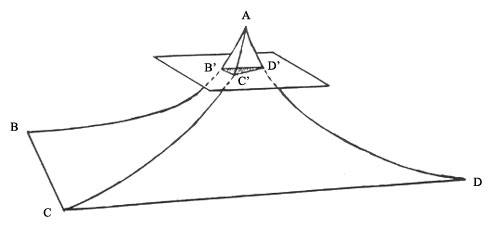
Figure 14
The power may seem to sit on solid and
absolute bases. An analysis of the top of the pyramid may show,
however, that
the power‑holder's position is not necessarily soundly established;
that
is, if it is not buttressed by factors of legitimization of power into
authority. In examining political power in particular, as we shall
touch upon
later, authority is intertwined with the power properties of the
complex and
should not be confused with it. The ruling strata may, for example,
exercise
its power legitimized by the religious beliefs of those submitting to
it. So,
the pyramid of power of the Sultan of Brunei will be different
from what was
that of Noriega in Panama. In the complex represented in Figure 14,
while the
ruled at the lower level are suppressed or subservient and may not be
able to
challenge the power structure because of tight control or relative
passivity
of the base, the power struggle takes place within the upper strata in
the form
of court intrigues, junta bargains and coups (the surface of support
for A
where the plane cuts the pyramid at intersection B'C'D').
Such was, for example, the case of Duvalier in Haiti. The
proposition is, of course, valid as long as the base is deprived and
subservient. When the base, through factors such as economic
development,
better education or communications and/or external factors,
becomes
politically aware and active, the power structure will undergo change,
civil
strife, upheavals and revolution. Such were the cases of the rule of
Muhammad
Reza Shah in Iran, Batista in Cuba or Somosa in Nicaragua. The
presentation
covers many contemporary societies in Latin America and the Middle
East. It is
also applicable to many European post‑Reformation kingdoms, and the
Romanovs in Russia.
The power structure of more developed and
distributive economies will have fewer non‑participating members at the
base and the controls within it depend more on diffusion of power
subject to
law and authority structures. (Figure 15).
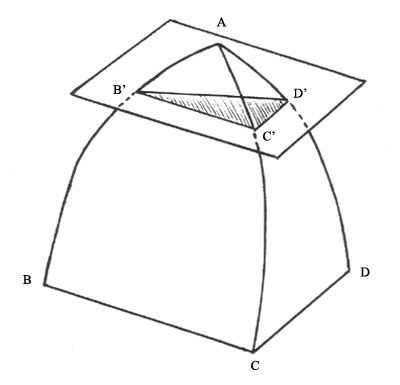
Figure 15
The rounder the edges of the pyramid, the
more integrated and diluted, the more consensual, the more law and
authority
oriented and the less concentrated the power complex will be. Some
social
theories have conceived of rounding the edges of power to the point of
turning
it into a sphere. Such theories assume that in a perfect power
distribution and
participation the lack of a base and seat of power is compensated by
the fact
that power participation is so enlarged that no matter how the
sphere rolls
the structure will hold together. In such a complex, whatever is
on top will assume
the responsibilities of the top, and the bottom will play the role of
the base:
anarchy in the "utopian" sense of Owen and Fourier, and younger
Marx's communism. The hypothesis is, of course, utopian. The communal
experiments that have survived are those such as the Hutterite
communities
where power is intertwined with strong religious and communal controls
establishing strict hierarchies.[86]
A more realistic pyramid for a developed
and reasonably distributive economy is a bellied pyramid as illustrated
in
Figure 15, where the middle class is substantial and the diffusion of
power is
significant. Looking at the top of such a pyramid, we see that the
power‑holders
are not pointing sharply upwards as in the autocratic regimes. The
status
differentiation is smaller at the top where the power structure is
solidly
situated (section B'C'D' in Figure
15). But then what it has is more authority, and less power,
accountable to
below. The President of the United States is not in great danger of
being
overthrown by a coup. But he mostly exercises legitimate power,
i.e.,
authority, and shares power with the Congress and the Supreme Court
and, in
more general terms, is influenced by all the other political
machinery of the
country, including state governments, parties and pressure groups.
This
implies, of course, as the figurative presentation can suggest, a
greater
surface of support and consequently a greater surface of friction. In
other
words, in an economically more developed and politically more
participatory
complex with a diffusion of power, the power‑holders have less chance
of
whimsical action. The pyramid also shows the weight of the middle class
on the
lower part of the pyramid and its magnitude as a whole. This
corresponds to the
formula of substantial middle class for stable political
institutions
advocated from Aristotle to our day.
Whatever the static illustration of the
pyramid, the power complex, in its dynamics, more closely resembles the
sphere;
not the utopian sphere of law and harmony, but a more energetic and
unsettled
one where the power‑holders seek the center rather than some peripheric
heights. Combining the different dimensions of power dynamics as
discussed in
the last pages and superimposing Figures 7, 8, and 9, we find the power
complex
appear as a sphere not unlike illustrations of atomic structures.
(Figure 16).
In that analogy, the identification of a
power complex will depend on what kind of an atom it resembles. Some
atoms hold
together better just as some power complexes do. There are
radioactive and
actinide atoms with more or less short spans of life which decay and
emit
energy, and their interaction with their environment alters their
nature.[87] There are atoms whose cohesion is such that
while they envelop an enormous amount of energy, they release that
energy only
when they are exposed to extremely high temperature (another form of
energy).[88]
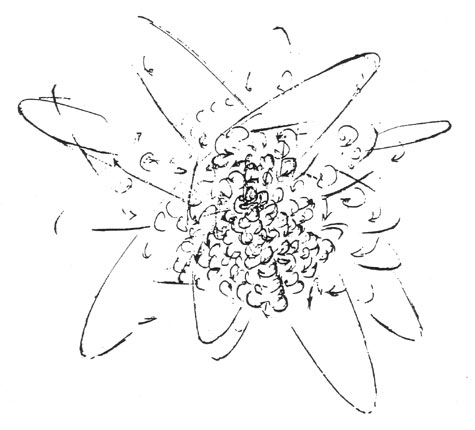
Figure 16
In terms of a human power complex all
depends on the cohesion of its components and how much of its energy it
has to
expend to hold itself together and mobilize itself and how much of
its energy
it can generate as a power complex. The proposition reverts back to our
earlier
discussions, from the nature of the product to the coefficients of
power. Using
different dynamics discussed in this chapter, a power complex may
circumscribe
its sphere in order to enhance the sensation or illusion of power
within. We
are referring to a gamut of situations from the exclusivity of clubs or
study
groups to development of jargons by professions, or economic
protectionist
policies by a country.
The circumscription can be used as a
vehicle for internal dynamics and cohesion and to create an
identity for the
sphere making its penetration by the components of other power
complexes more
difficult. Rules of the game, so to speak, develop. Different sources
of power
evolve in particular ways and gain different weights creating specific
social
patterns. In some cultures title and pedigree (reputation) may become
the
weightier source of power, in another money (means), and in yet another
different combinations of networking and connections. In any of these
variations, of course, consciousness of power and the capacity to
effectively
analyze, evaluate and act will give the edge to the power seeker. But
the
prevalent and prescribed patterns of behavior can condition that
capacity, i.
e., in different cultures consciousness and analytical qualities are
sharpened
towards acquiring title, wealth or connections.
Circumscription of the sphere may make
the power complex itself less agile in penetrating other power
complexes. The
name of the game in the United States may not be the same as in France.
A
successful American power complex may not be able to operate as
successfully
within the French environment. All this again depends on the
adaptability of a
power complex, and the potentials it has bottled up within its sphere.
When
Commodore Perry dropped anchor in Edo Bay in 1853, Japan was a power
complex
enclosed unto itself. The history of Japan since then provides a
graphic
illustration of the dynamics of the sources and spheres of power
covered so
far.
VIII
RESISTANTS OF POWER
In
the social setting, when the dominant and the dominated components of a
power
complex are absolutely integrated in their relational circuit, the
totality
that ensues should be taken into account as one power entity. It is
like a
healthy body in which the kidney and the nose have coordinated
functions within
the whole and do not exercise power over each other. To become a
reality of
power, that body, as a potentio‑kinetic entity, should come into
contact
with its environment, i.e., spheres of other powers. In a vacuum, in
terms of
dynamics of power, it is as good as nonexistent. As we saw
earlier, power is a
relationship. It involves the domineering and the submitting or
contesting
factors.
Even
in the personal power relationship between parents and the child, what
remains
outside that particular complex creates other power relations. Beyond
the
limitations and permissions of the parent‑child relationship, the child
fits into other environmental situations. His relationships with
other
children or his imaginary domination over his toys or his pet
create within
him attitudes often influencing his behavior in the parent‑child
power
complex.
The
very unknown and undominated surroundings of an isolated ruler and his
subjects
are factors which may influence and limit his power complex and the
behavior of
his subjects who, in one way or another, make use of the surroundings.
But
these are extreme examples. In the societal context power
complexes operate in
promiscuity. They often overlap and interpenetrate each other and in
their
spherical dynamics come into conflict, cohabitation or
cooperation. Vacuums do
not remain vacuums. When the United Kingdom, in order to compress its
area of
control after the components of its power had thinned out,
announced its
withdrawal from the east of the Suez Canal, the expanding U.S.,
U.S.S.R., and
other local powers prepared to take over. One of the consequences was
the
emergence of Iran as a regional power with its own internal
contradictions
which eventually gave rise to Islamic fundamentalism energizing, in
turn, other
power complexes. There exists thus a spectrum of endogenous and
exogenous
dynamics for power complexes in time and space.
In
the struggle for domination and power, the hierarchy of the components
of the
power complex does not organize itself without clashes, gropings,
repeated
encounters, perseverances, and challenges.
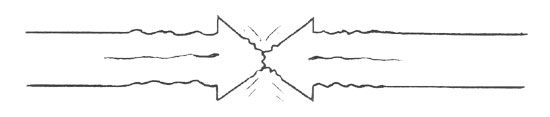
Figure
17
Clashes
may cause the contenders to keep aloof from each other, in which case
it may be
said that no power relationship is established between those particular
contenders.
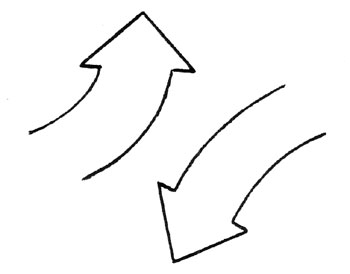
Figure
18
The
power that can be generated will depend on the combination of the
contending
factors and the extent and shape in which they fuse and amalgamate.
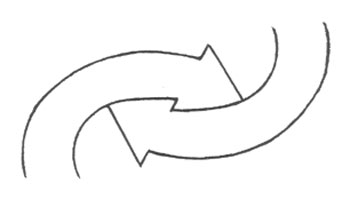
Figure
19
There
will, at once, be the centripetal gravitation for active contact
and
engagement, and centrifugal tendency for freedom, escape and possible
attraction to other contenders.
As
we proceed in this discussion of the relational nature of power, the
implication seems to be that power cannot be conceived alone. In
its
relativity it needs at least two components: power and its antimony. In
human terms
the consciousness of power will tend to call for the consciousness of
the
elements over which it has power. What is the power which is not
challenged? In
the manner of Caligula, power may push its docile subjects to the
brink of
revolt in order to feel their resistance and thus feel itself.[89]
Power,
then, is conditional to resistance to such an extent that it
cannot be
conceived without it:  .
It follows that there will be degrees of externality and
internality of resistance in relation to power such that in the absence
of
relatively external challenge, the substantiation of power
ferments resistants
within. Indeed, intrinsic resistants do not ferment only when the
comparatively
foreign challenge has ceased. Their germs are ever present within the
power
complex so that in the potentio‑kinetic sense power does not cease to
exist. This existential relational nature of power implies that
resistance is
part and parcel of power
.
It follows that there will be degrees of externality and
internality of resistance in relation to power such that in the absence
of
relatively external challenge, the substantiation of power
ferments resistants
within. Indeed, intrinsic resistants do not ferment only when the
comparatively
foreign challenge has ceased. Their germs are ever present within the
power
complex so that in the potentio‑kinetic sense power does not cease to
exist. This existential relational nature of power implies that
resistance is
part and parcel of power  .
Lord Acton's "Power
corrupts and absolute power corrupts absolutely, " was not only a
moral maxim but a precept for good government, empirically
conceptualizable,
which led him to emphasize the need for an opposition even within
legitimized
power.[90] This Janus characteristic of power evokes
the dyad of man's existence with which we started our study. The drive
for
domination emanates from man's dilemma: to be or not to be. It seems,
at least
through man's vision and understanding of the phenomena, that this is
not
confined to man but is the law of nature. In physics, at the
subatomic level,
when energy turns into matter, it does so in pairs: an atomic particle
(electron) and the symmetric antiparticle (positron). At the other end
of the
scale we now seem to discover that our universe and its constellations
are
contained in their infinity by the dyad of matter and anti‑matter. Spin
the two arrows in our Figure 19 and what you get will not be far from a
celestial constellation.
.
Lord Acton's "Power
corrupts and absolute power corrupts absolutely, " was not only a
moral maxim but a precept for good government, empirically
conceptualizable,
which led him to emphasize the need for an opposition even within
legitimized
power.[90] This Janus characteristic of power evokes
the dyad of man's existence with which we started our study. The drive
for
domination emanates from man's dilemma: to be or not to be. It seems,
at least
through man's vision and understanding of the phenomena, that this is
not
confined to man but is the law of nature. In physics, at the
subatomic level,
when energy turns into matter, it does so in pairs: an atomic particle
(electron) and the symmetric antiparticle (positron). At the other end
of the
scale we now seem to discover that our universe and its constellations
are
contained in their infinity by the dyad of matter and anti‑matter. Spin
the two arrows in our Figure 19 and what you get will not be far from a
celestial constellation.
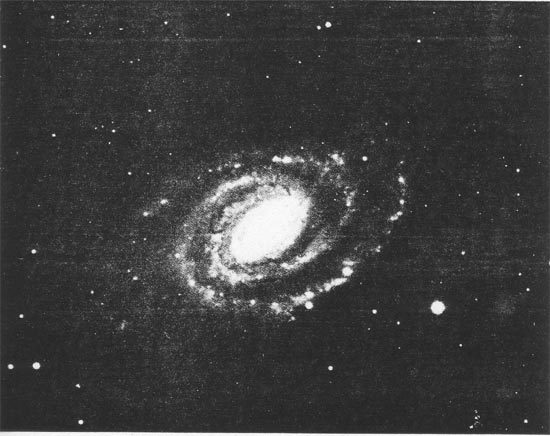
Spiral
Nebula in the
Constellation Virgo.
Photographed
by Mt.
Wilson and Palomar Observatories.
Figure
20
And
gazing into the skies and fearing and searching the unknown beyond his
grasp,
which gives him light and darkness, heat and cold, and life and death,
man has
perceived power in the elements and conceived it in human terms.
The
magnanimous and mean streaks of the Greek and Aztec gods, the
Zoroasterian Ahurmazda
and Ahriman, Nirvana (being and nothingness, affirmation and negation),
and
Ying and Yang in Eastern religions, God and Satan in the
Judeo‑Christian
religions are all manifestations of the dyadic nature of power.
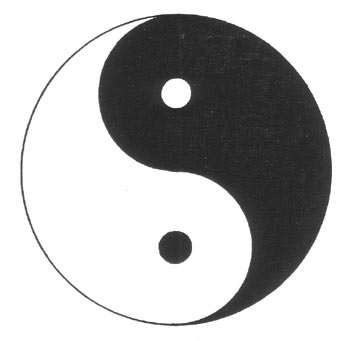
Figure
21
The
dyadic conception of the supernatural power does not only arise from
man's
perception but also from his consciousness about the coefficients of
power and
its intrinsic resistants. By injecting them into his idea of the
holy he can
at once expect (and indeed demand) the supernatural to accomplish
miracles ‑‑
because of the coefficients ‑‑ and negotiate with it ‑‑
because of the intrinsic resistants: as supernatural powers settle
their
accounts within, man can take sides and bargain and explain his
non‑conformity
with certain wishes of the gods.
The
observation leads us to a fact of much greater significance for
our inquiry.
It is that not all men gazing into the sky or in awe of the mystery of
creation
come up with an explanation. Those who do have an edge on the others.
Remember,
the power of the totem accrues to the shaman. What is pertinent to our
study is
that those who claim knowledge of the mysteries of heaven use the power
of the
supernatural to legitimize their own power ‑‑ and that of others
(the divine right of kings) ‑‑ into authority. We thus reach the
point of power/authority conversion. While, as we have seen, power
cannot be
confined to its human perception, authority is manmade. Making the
distinction
between the two is crucial for our understanding of social
phenomena and
political organizations. We take the liberty of a short incursion into
the
conversion of power into authority to underscore this point.
IX
FROM POWER TO LAW AND AUTHORITY
Man's central dilemma in the
potentio‑kinetic context of power
remains the
fact that whether in a situation of clash between contesting
powers or in that
of dominant and dominated elements, the subservient constantly
feels the
pressure of the power-holders and the latter need to incessantly
exercise
their power in order to affirm it.
We don't know about the existence of
consciousness in supernovas, collapsars, electrons and positrons but,
within
time and space, human consciousness soon realizes the lack of security
in this
two dimensional nature of power both for those who submit to power and
those
who exercise it.[91]
TEMPORAL AND
COEXISTENTIAL PHENOMENA
The temporal
continuum leads to the observation of recurrences and the
accumulation of
experience: In the long run, the contested powers harden, become
breakable or
erode, and are overtaken by others. Looking into the past, present
powers may
seek ways of securing their own power, and also, creating conditions
which make
submission, if and when it befalls them, more bearable. The more
recurrent the
power shifts, the greater the likelihood of powers' consciousness
of the need
for stability.
The spatial factor is the coexistential
reality of power: the inevitable
coexistence of clashing powers and
the unavoidable friction between the superior and the subordinate. The
co‑existential
reality, in the context of the temporal continuum, soon leads to the
realization of the need for accommodation. The powers that
accommodate create
bonds, bounds and servitudes for themselves. In other words, part of
their
power is transformed into an authority which sets standards upon them
for the
sake of order, stability and predictability. The proposition
hinges on
responsibility and accountability. Power does not have to justify its
actions ‑‑
more on justification later. Authority is answerable and has to respond
toy
someone or some institution which may not necessarily be the
subordinate,
and/or it may have to behave in some prescribed way. So, in
addition to the
two dimensions of command and compliance (or clash), arises a third
dimension
of interaction calling for responsibility.
As we noted at the beginning of this
inquiry, it is at the international level, at the point of encounter of
autonomous and alien entities, that the distinction between power and
authority
can best be demonstrated. International law has authority to the extent
that
those submitting to it recognize it: pacta
sunt servanda. In the absence of a coercive power above the will
of
sovereign states, the confronting powers recognize an area of
accommodation
where they create an authority binding them. They do so to the extent
they
perceive the temporal/coexistential phenomena. (Figure 22)
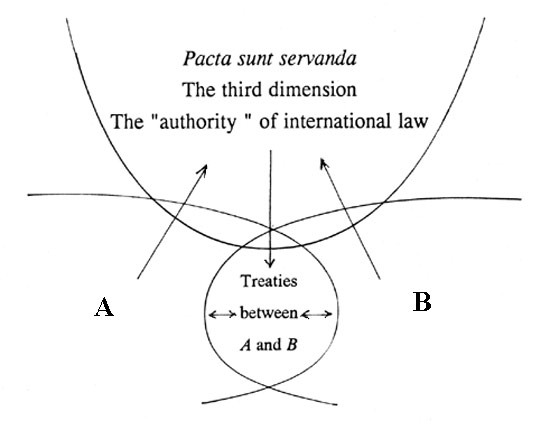
Figure 22
The autonomy and distinctiveness of
states account, to a large extent, for the rather precarious nature of
international law. Because the powers that be do not identify with
enough time
series of rise and fall of powers to conclude that in the long run
yielding
part of their power to a normative system could contribute to the
stability of
their relations with each other and the security for the exercise
of that
portion of their power they have retained. Indeed, where
interdependence
increases and spatial distances are reduced due to development of
communications, and where past experiences are identified with by those
involved, the chances for the conversion of the power of the states
into
authority become greater, as has been the case with the European
Community. But
such instances have been rare in the history of international relations.
In closely‑knit small human
communities, the temporal and coexistential phenomena ‑‑
accumulation of experiences and observation of recurrences within
the
collectivity ‑‑ are close at hand. Recall our earlier discussion of
domination drive. As the individual drives for domination, he also
observes ‑‑
very close at hand ‑‑ the growth, potency and decay of other
individuals: his parents, himself and his offsprings. Thus, into the
family,
the clan and the community soon seep norms of conduct: honor thy
father and
thy mother; love and respect. As Hegel put it, the immediacy of a
child's
potential freedom are mediated through education into ethical
principles.[92]
NATURAL, RATIONAL AND NORMAL BEHAVIOR
To provide continuity, stability and
predictability within a community, norms of conduct create bonds and
put bounds
on the natural inclinations and self‑centered rationales of the
individual. The natural inclination of a person in heat may be to rape
another
person. The rational selfish behavior of a hungry man would be to grab
the food
of a weaker person. The natural inclinations can lead to brute force;
the
rational calculations, free from norms, can result in unscrupulous use
of
power. Norms restrain and constrain raw exercises of power. They
develop as the
natural and rational potentials of man are conditioned by the
temporal/coexistential realities. In the last analysis norms have some
natural
and rational bases. The logic of "thou shall not kill" is that you
don't kill and others don't kill you.
But temporal and coexistential phenomena
may obscure the original natural and rational bases and substitute them
as the
sources of the norms. A person will behave in a given way because it is
normal;
normal because others have behaved and are behaving that way. In some
instances
the natural and rational bases may no longer apply but the traditional
(temporal) and collective (coexistential) realities maintain the norms
and
mores. Eating pork may have been proscribed in Judaism because of the
observation that it could cause trichinosis. Modern hygiene has removed
the
cause but not the practice.
A normative system of right and wrong,
good and bad, allowed and forbidden thus emerges which finds its
justification
in the collective stability and the predictability it provides.[93] One begins to do or not do as others have
done and do, or have not done and do not do. The justification for the
binding
precepts are the temporal and collective phenomena. Here we have the
primary
elements for 1) law :
the binding nature of norms; 2) justice : the
justification of the norms, and; 3) tradition : the
confluence of the temporal and collective
phenomena. The proposition covers the evolution, over time, of
microcosmic
clashes and cooperations among members of families and clans into mores
and
morality within homogeneous communal settings.
The spectrum of conversion of power into
law and authority thus extends from the development of moral norms
within a
community at one end to the development of international law among
states at
the other end. Between the two, in different social structures,
the conversion
of power into authority takes a few more twists in the relationship
between the
dominant and the dominated in order to make it possible for some within
the
society to take certain liberties that others cannot take.
To enjoy their power with stability and
with little use of coercion, powerholders should justify their
domineering
position and the discrepancy between what they can do and others
cannot. Above
all, that justification should be accepted by those they dominate and those who may contest their power. In
a nutshell, to take liberties, power uses coercion while authority uses
justification. Nutshells, of course, deform and banalize. The
conversion of
power into authority is the feat of human social organization: turning
power
into law to legitimize power into authority in order to exercise power
legitimately. (Figure 23).
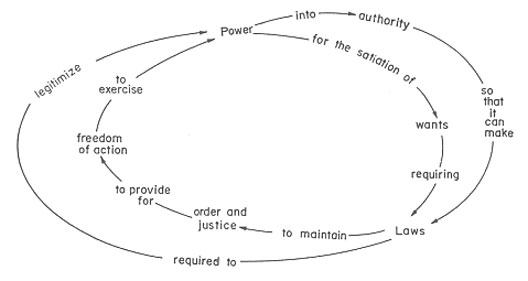
Figure 23
LEGITIMIZATION PROCESSES
As the loops in Figure 23 show, it takes
power to create authority. Between the two dominant and dominated
dimensions of
the power complex, legitimization arises as a third dimension
binding the two
together. It permits the transformation of the lieutenants of the
conqueror
into the sheriffs of the kingdom.
For this conversion, what power has to
work with and against are its inherent coefficients and resistants. It
is the
balancing and compromising of the two that produces the legitimizing
dimensions.
The stronger the coefficients, the more overwhelmed the resistants and
the more
arbitrary the laws. Cases in point are periods of rule by charismatic
leaders
and certain periods in revolutions; the coefficient being popular
enthusiasm,
terror or popular hysteria. In such cases the legitimizing
dimension can be
rather thin and when the coefficient subsides the authority system has
to stand
the test of time.
Of course, in historical terms, the move
from the exercise of power to its legitimization into authority is
not a
constant progression. Where authority is challenged by new powers or
itself
slips beyond the value system which legitimizes it, the need for new
dynamics
of conversion arises. Thus, for example, as a reaction to the tyrants
of sixth
century B.C. the ideas of democracy, rule of law and constitutional
government
were developed by Greek statesmen and philosophers like Pericles,
Socrates,
Plato and Aristotle. And the Reformation, the religious wars and the
emergence of
absolute monarchies in Europe gave rise to significant religious,
philosophical
and literary debates on the legitimacy of power.[94]
The processes and methods of legitimizing
power into authority are easier to identify when the coefficients and
the resistants
are mediated and compromised by the domineering and the dominated
within a
common value system, such as the rule of a Christian monarch over a
Christian
population, both believing in the divine right of kings. We have
identified
elsewhere the two main legitimizing processes as consecration
and constitutionalization.[95] In
consecration the legitimizing dimension is derived from beyond the
power
complex itself, either the supernatural
– such as the divine right of kings ‑‑
or the traditional – rooted in
times past. In
constitutionalization legitimization is mediated within the power
complex and
its venues are contractual – drawing
on theories of social
contract – and representational – based
on concepts of voting, elections
and majority rule. We need not elaborate on these processes here and
refer the
reader to the earlier writing.[96] What is of interest
to our present
study of the conversion of power into authority is that each process of
legitimization runs within a spectrum, at one end closer to power, at
the
other, to authority.
It is not so much the adherence of the
powerful to the process which determines where within the spectrum a
regime
should be placed, but how effective is the value system on which it is
based.
The Christian king may not only believe in the divine right of kings
but may
also be a very pious Christian. The president of the republic may be
properly
elected. But both the king's and the president's authority will depend
on how
coherently the whole polity upholds the value system on which their
authority
is based. Ion Iliescu received 85 % of the votes for the presidency of
Rumania
in 1990, yet he had to call on coercive elements to claim his
authority, while
François Mitterrand, who was elected with 53 % of the votes to
the presidency
of France in 1988, has had little crisis of authority. At issue is the
justification of the third dimension – the legitimizing dimension ‑‑
and whether the dominated believe it is imbued with justice.
JUSTIFICATION
= JUSTICE
To make the point, let us take, for
example, the traditional process of conversion of power into
authority where
legitimization is based on the temporal/coexistential phenomena.
We noted earlier
that it served effectively to develop moral norms within homogeneous
communities. When applied in a differentiated heterogeneous society,
the
process reveals Austinian characteristics. That is, as John Austin put
it, the
authority system is effective when "the
bulk of the given society are in a habit of obedience or
submission to a determinate
and common superior.”[97] The
"bulk," the "habit"
and the "determinate and common superior" imply the traditional
continuum. Yet, the proposition can work where the differentiation
between the
liberties of the superiors and the norms imposed on their subjects is
not
glaring.[98] Without any other justification than
"because others have done it that way", great discrepancies can
become questionable. Failing justification, the "authority" will have
to resort to coercion. Indeed, Austin's description of positive law is
based on
the habit of obedience and the fear of punishment.[99]
In this traditional model we are
presented with a spectrum with, at one end a communal setting with
little
differentiation and its norms justified by their resilience and,
at the other
end, an authority with differentiated norms and great propensity to be
based on
coercion.[100]
The spectrum of coercion/justification
evokes the utilitarian and behaviorist concepts of pain and pleasure,
and
punishment and reward; yet it should not be confused with them.
Ours takes
off, in part, from our earlier discussion of persuasion as a
component of
power. There is an element of persuasion in the conversion of
power into
authority. Part of power's persuasive coefficient is used for
legitimization,
compromising the power in a value system binding upon it as well. The
value
system will, of course, present a hierarchy in the norms of conduct in
favor of
the powerful. The more those subject to the power believe in the
righteousness
and justice of the value system, both legal and social, the more
effective it
becomes as a legitimizing factor, justifying the discrepancies. When
the
accused, as a Sudra, believes that he deserves the punishment of the
king which
purifies him for his next reincarnation and his peers think so too, we
have a
system of authority whose laws are found to be just by those who submit
to it.[101] Here we are, of course, dealing with
valuational content of justice. The example of the Sudra should not
imply that
the totalitarian justification of power should necessarily rest on
superstitious grounds. In the Moscow trials of the 1930's many of those
accused
of treason by Stalin confessed to their crimes against communism,
despite being
devoted communists ‑‑ and because of it. According to some
accounts, which are now being substantiated, they did so because
dialectically
they were convinced that their confession would maintain the legality
of their
ideology.[102]
Within a differentiated heterogeneous
society where different value systems cohabit and compete to serve
as bases
for righteousness, those who do not find certain laws just in the
valuational
sense may submit to the broad authority system to preserve the civil
society.
The concept of nolo contendere, besides
its common interpretation of non‑admission of guilt, implies that the
accused does not contest the facts of the case and submits to the
court's
verdict but considers that his action should not have been
illegal. He may do
so because he may believe that, despite the injustice of the
particular law,
due process has been applied and it is in his ‑‑ and the common –
interest to have the legal institutions respected. While his interest
in having
the legal institutions respected may imply his belonging to the
weightier part
of the society – the domineering elements – his consideration of the
due
process evokes the principle of fairness in our equation of
justification and
justice.[103]
The fairness characteristics of justice
are present within our spectrum of coercive power and just authority.
At some
points within the spectrum, in a differentiated heterogeneous power
complex,
when value systems are at odds, due process and strict observance
of the law
may become the minimal fabric of social cohesion. As Barry puts it "the more a society is divided on
substantive values, the more precious as a means of preserving social
peace is
any agreement that can be reached on the procedure.”[104]
On our spectrum, Barry's proposition
approaches the adherence of sovereign states to international law. Even
at the
international level there are gradations within the
coercion/justification
spectrum. States carve out of their sphere of power certain areas of
law and
authority corresponding to different degrees of justification or
coercion. The
development of Western international law, for example, was steeped
in the
evolution of the rights of Christian sovereigns. Where a common value
system is
more or less applicable, it is evoked to buttress agreements. In the
absence of
common values, the coercive phenomenon becomes more operative and
powers keep
to their pacts as long as there is balance of power. Hence the
existence of the
debatable clausula rebus sic stantibus in
international law. Balance includes the perception of the parties about
each other's
capacity to inflict harm. The retribution may not be outright act of
war but
hostage‑taking by the proxies of one power which may not have the
material capacities of the other one but has a value system which puts
less
emphasis on human life. Such have been, for example, the cases of
hostage‑taking
in the Middle East.
The principle of fairness as formulated
by Rawls implies a consciousness on the part of the members of the
society
about their social rights and duties.”[105] It fits into the constitutionalization
process for the conversion of power into authority. But in so far as
the broad
masses are not consciously engaged in cooperative ventures
according to agreed
upon rules limiting their liberties for the common good, due process
can
obfuscate questions relating to the justification of laws and
authority. Hence
the concepts of equity and social justice and debates in legal
philosophy about
"rights" in the legal sense and "what is Right" in the
moral sense. Our concern here is not a debate on what is and what ought
to be[106]
but their perception by different segments within a power complex.
When the tenant who cannot pay the rent
willingly leaves the house because he feels that as a retired person
the owner
needs the income, the tenant finds the owner's right Right. When more
and more
renters refuse to leave and find the owners to be exploitive
landlords, the
owner's right is less and less Right to the extent the society
sympathizes
with the tenants. The more landlords have to call on the police and the
courts
to evict renters, the more authority is used for contested power. The
justice
of the peace may be exercising his authority and reach his verdict with
due
process, but there will be little justice in his verdict in the eyes of
the
convicts and their sympathizers.
Note, however, that the assumption here
is that the legal system supports the established order as the
weightier part
of the society. The identification of the weightier part of the society
by the
legal system will, of course, depend on the value systems present.
Where the
legal system is directly an issue of the legitimized power and
answerable to it
alone, it becomes part and parcel of it. Such are, for example, cases
of
theocratic and totalitarian regimes. Under such regimes, the perception
of
justice is closely related to the justification of the privileges
of the
weightier part of the society by the prevailing value system. In 1990,
squatters in Moscow occupied apartments which were built for the
communist
party officials who could once justify their own special treatment by
the heavy
burden they had assumed to lead the proletariat to the classless utopia.
But where the legal system is relatively
independent of the coercive structures, it may become sensitive to
weight
shifts within the society. Such has been, for example, the evolution of
the
common law. There is also the case of religious systems dispensing
laws, with
belief serving as the legitimizing dimension of monarchies, and in
return the
monarchs upholding and propagating the spiritual authority of the
religious
system; the two serving as checks and balances to each other.
The dependence of different powers on
each other for the legitimization process is indeed the measure of
justice and
justification of authority. One of the causes of the Reformation
was that more
and more Christians – including Christian princes – found the
Catholic
church's expanding land ownership not Right. Yet, at some point in the
history
of the Church of Rome, the coefficient of religion had been so
overwhelming –
the terror of God so great ‑‑ that it justified the donation of
land to insure God's ultimate "justice".
There will be the powerful who will have
the law on their side and may find it just as it is. In the
heterogeneous
social context chances are that there will always be some who contest
the
justice of certain laws. Depending on their importance, they may cause
social
disruption or they may remain marginal to the power/authority
conversion system
which may otherwise have a broad base of justification. Within the
spectrum
going from coercion to justification, the legitimate power,
authority and the
legal system can thus be located at different points. At one
extreme, laws can
become the coercive tools of power with an appearance of authority, at
the
other extreme, in a homogeneous community or a monolithic belief
system, they
can be immersed in moral codes binding the whole together, with
patterns of
behavior inside each member and little apparent outside coercive
body – as in
the case of Hutterite communes mentioned earlier.
It would not be only a jeu de mots to
say that, at least in the
Western civilization, the words law and justice carry in their origins
the
concepts developed here. Lex, the
Latin origin of the word law is derived from legere which
means binding together. Justice is derived from jus
which also means juice and broth.
For those who began conceiving these social phenomena, law constituted
the
ligaments binding the members of the society together while justice
lubricated
those ligaments. The more there is justification, justice and juice
within the
body politic, the society and the organism, the less dry and squeaky
will be
the ligaments and the laws.
X
CONCLUSION
In
our incursion into the conversion of power into authority we have
trespassed
into the domain of legal philosophy. Continuing our research in that
context
can deviate our attention from the premises we have already established
in the
distinction between power and authority. Indeed, one of the
difficulties in
identifying social power is its propensity to flow into other
social dimensions,
whether law, economy or religion, and to confuse with them. Yet, it is
important to distinguish between power and authority, because
while power
seeks security for its power through legitimization into
authority, authority
has an endemic tendency towards power. It is that the dulled
coefficients and
tamed resistants cease to be stimulants. While authority addresses
man's needs
for security, order and predictability, power tantalizes his cravings
for
challenge, game and adventure.
We
began this inquiry by an attempt to formulate power relationships. But
as our
reflections on power continued, more variables emerged. Such were
the
relationships between the product and the goal, the comparative
evaluation of
different sources of power, the solidity or precariousness of a power
complex
depending on the shifts in its sphere of power, the coefficients and
resistants
of power and their use in creating the legitimizing dimension for the
conversion
of power into authority, the temporal and coexistential phenomena which
condition power and develop norms which, in turn, are used both for the
control
and the exercise of power, the interrelated spectra of
coercion/justification
and law/justice and their role in distinguishing between power and
authority.
For
the measurement of these variables we would need multidimensional
matrices and
complex quantification and computation facilities which, as yet,
are not
available. The essential fact to retain, however, is that while
measuring that
which is measurable in the study of power, one should not lose sight of
those
aspects of power which are not within quantitative grasp. The reduction
of the
phenomenon to its measurable properties can distort the perception and
understanding of the phenomenon. As we measure, we should keep the
unmeasurable
in mind; it can have an effect on our measurements.
Of
course, no awe of the unmeasurable aspects of power is implied. The
scientist
and the philosopher should remain aloof and simply be conscious of them
in
order to have a better perspective for analysis. The awe of power
is for the
philosophically uninitiated; both those who submit to it and those who
exercise
it. The case of the latter is the more ominous and worthy of close
observation.
It is when the powerful, whether prophets, visionary leaders or
dictators,
mistake the coefficients of their power for a mystic mission that
they become
prone to catastrophes. That is a significant manifestation of man's Vorstellung of power in heavens beyond.
“I go the way that Providence dictates,
with the assurance of a sleepwalker”, said Hitler.
SELECTED BIBLIOGRAPY
Ador
no, Theodore W., Else Fenkel‑Brunswik, Daniel J. Levinson and R. Nevitt
Sanford, The Authoritarian Personality, New York, Harper, 1950.
Alker,
Hayward, Karl W.Deutsch, and Antoine Stoetzel, (eds), Mathematical
Approaches To Politics, San Francisco, Jossey‑Bass, 1973.
Arendt,
Hannah, The Origins Of Totalitarianism, New York, Harcourt
& Brace,
1951.
‑‑
, On Revolution, New York, Viking Press, 1963.
‑‑
, On Violence, New York, Harcourt, Brace & World, 1970.
Aristotle, The Works Of Aristotle,
Edited by W.D. Ross, Oxford,
Oxford University
Press, 1908.
‑‑
, The Complete Works Of Aristotle, edited by Jonathan Barnes,
Princeton,
N.J., Princeton University Press, 1984.
Aron, Raymond, "Macht, Power,
Puissance: Prose
démocratique ou poésie démoniaque?", in Archives
Européenes de
Sociologie, V, 1 (1964), pp.27‑51.
‑‑
, Power, Modernity, And Sociology, Selected Sociological Writings,
Brookfield, Vt., Gower, 1988.
Ash,
Maurice, "An Analysis of Power, with Special References to
International
Politics," World Politics, 3, 1951, pp. 218‑237.
Austin,
John, (1832), The Province Of Jurisprudence Determined. New
York, B.
Franklin, 1970.
Bachrach,
Peter, and Morton S. Baratz, "Two
Faces of Power," in American Political Science Review, 56,
1962,
pp. 947‑952.
‑‑
‑‑ , "Decisions and non‑decision," in American
Political Science Review, 57, 1963, pp. 632‑642.
‑‑
‑‑ , Power And Poverty, New York, Oxford University Press,
1970.
Bacon,
Francis, Meditationes Sacrae, 1597, numerous editions.
Baker,
Ernest, Nietzsche And Treitschke: The Worship Of Power In Modern
Germany,
London, Oxford University Press, 1914.
Baldwin,
David A., "Money and Power," in Journal Of Politics, 33, 1971,
pp. 578‑614.
‑‑
, "Power Analysis and World Politics: New Trends versus Old
Tendencies", in World Politics, 31, 2, 1979.
Banfield,
Edward C., Political Influence, New York, Free Press, 1961.
Barry,
Brian, Political Argument, London, Routledge & Kegan, 1965.
‑‑
, (ed.), Power And Political Theory: Some European Perspectives,
London,
Wiley, 1976.
Bell,
Daniel, "Is there a Ruling Class in America?" in Bell, (ed.), The
End Of Ideology, New York, Collier, 1962, paperback, rev. ed. pp.
47‑74.
Bell,
David V. J., Power, Influence And Authority: An Essay In Political
Linguistics, New York, Oxford University Press, 1975.
Bendix,
Reinhard, "The Mandate to Rule: An Introduction" in Social Forces,
55, 1976), pp. 242‑255.
Bergson, Henri, L’Evolution
Créatrice, Paris,
Alcan, 1907.
‑‑ , Les Deux Sources de la
Morale et de
la Réligion, Paris, Alcan, 1932.
Blair,
G. A., "The Meaning of 'Energia' and 'Entelechia' in Aristotle", in International
Philosophical Quarterly, 7, 1967, pp. 110‑117.
Blau,
Peter, Exchange and Power in Social Life, New York, John Wiley,
1964.
‑‑
, Inequality and Heterogeneity: A Primitive Theory of Social
Structure,
New York, The Free Press, 1977.
Bose,
Nirmal Kumar, Selections From Gandhi, Ahmedabad, Navajivan
Publishing
House, 1948.
Bossuet, Jacques, La Politique
Tirée de L'Ecriture
Sainte, (1679), Paris, Gallimard, 1979
Bradshaw,
Alan, "A Critique of Steven Lukes' 'Power: A Radical View'", Sociology,
10, 1976, pp. 121‑128.
Brentano, Franz Clemens, Psychologie
vom Empirischen
Standpunkt, 1874, 1911, Leipzig, Meiner, 1924 (Vol. I.) 1925 (Vol. II).
"Brutus,
Stephen Junius" (pseudonym), Vindiciae Contra Tyrannos, (1579),
see infra. J.H. Franklin.
Burns,
Tom R., and Walter Buckley, Power and Control: Social Structures
and Their
Transformation, London, Sage, 1976.
Calvin,
Jean, Institutes of the Christian Religion, (1536), Grand
Rapids, Mich.,
W.B. Eerdmans Pub. Co., 1986.
Canetti,
Elias, Crowds and Power (1910), London, Gollancz, 1962.
Cannon,
W. B., "Voodoo Death," American Anthropology, 44, 1942, p.
169.
Cartwright,
Dorwin, "A Field Theoretical Concept of Power," in D. Cartwright,
(ed.), Studies in Social Power, Ann Arbor, University of
Michigan Press,
1959, pp. 183‑220.
‑‑
, "Influence, Leadership, Control," in J. March (ed.) Handbook of
Organizations, Chicago, Rand McNaly, 1965, pp. 1‑17.
Centre Aixois de Recherches
Anglaises, Le Pouvoir dans
la Litterature et la Pensée Anglaises, Aix,
Université de Provence, 1981.
Cheney,
Dorothy, and Robert Seyfarth, How Monkeys See The World: Inside the
Mind of
Another Species, Chicago, University of Chicago Press, 1990.
Churchill,
Winston S., The Second World War, 6 Vols., Boston, Houghton
Mifflin Co.,
1949.
Clark,
Kenneth B., Pathos of Power, New York, Harper & Row, 1974.
Clements,
Fredric E., "Social Origins and Processes Among Plants," in C .A.
Murchison (ed.) A Handbook of Social Psychology, (1935), New
York,
Russell & Russell, 1967.
Cline,
Ray S., World Power Assessment: A Calculus of Strategic Drift,
Boulder,
Colorado, Westview, 1975.
Coleman,
James S., Power and the Structure of the Society, New York, W.
W.
Norton, 1974.
Connolly, William E., The Terms of Political Discourse, Lexington, Mass., Heath, 1974.
Coser, Lewis, "The Notion of Power: Theorethical Developments", in L. Coser and Bernard Rosenberg (eds), Sociological Theory: A Book of Readings, New York, Macmillan, 1976, 4th edition, pp. 150-161
Craven,
C. Jackson, Our Atomic World, Oak Ridge, Tennessee, U.S. Atomic
Energy
Commission, 1964.
Dahl,
Robert A. "The Concept of Power," in Behavioral Science, 2,
1957, pp. 201‑215.
‑‑
, Who Governs?, New Haven, Yale University Press, 1961.
‑‑
, Modern Political Analysis, Englewood Cliffs, Prentice Hall,
1963 and
1970.
‑‑
, Pluralist Democracy in the United States: Conflict and Consent,
Chicago, Rand McNally & Company, 1967.
‑‑
, "Power," in International Encyclopedia of The Social Sciences,
New York, Macmillan and Free Press, 1968. Vol. 12, 405‑415.
Debnam,
Geoffrey, The Analysis of Power: A Realist Approach, London,
Macmillan,
1984.
Derrida,
Jacques, (1967), Writing and Difference, Chicago, University of
Chicago
Press, 1978.
‑‑
, Of Grammatology, (1967), Baltimore, Johns Hopkins University
Press,
1974 -1976.
Descartes,
Rene, The Principles of Philosophy (1644). Numerous editions.
Deutsch,
Karl, The Nerves of Government. New York, Free Press, 1966.
Doob,
Leonard W., Personality, Power, and Authority: A View from the
Behavioral
Sciences, Westport, Conn., Greenwood Press, 1983.
Dornbusch,
Sanford M., Evaluation and The Exercise of Authority, San
Francisco,
Jossey‑Base, 1975.
Durkheim,
Emile, The Division of Labor in Society, (first published in
French in
1893), New York, Macmillan, 1933.
‑‑
, The Elementary Forms of the
Religious Life, (first published in French in 1912), Glencoe, Ill.
Free
Press. 1947.
Emerson,
A. E., "The Biological Basis of Social Cooperation," in Illinois
Academy of Science Transactions, 39, 1946.
Emerson,
Richard M., "Power‑Dependence Relations", American
Sociological Review, 27 (February 1962), pp.31‑41.
Entrevès,
Alexander Passerin d', The Notion of the State, An Introduction to
Political
Theory. Oxford,
Clarendon, 1967.
Fenelon François, Les
Aventures de Télémaque,
(1699), numerous editions.
Fogelson,
Raymond D., and Richard N. Adams, The Anthropology of Power:
Ethnographic
Studies from Asia, Oceania and the New World, New York, Academic
Press,
1977.
Franklin,
Julian H., Constitutionalism and Resistance in the Sixteenth
Century: Three
Treatises by Hotman, Beza, and Mornay, New York, Pegasus, 1969.
Frey,
Frederick W., "Comment: On Issues and Nonissues in the Study of
Power", American Political Science Review, 65, 1971,
pp.1081‑1101.
French,
J.R.P., Jr., "A Formal Theory of Social Power," in Psychological
Review, Vol. 63, 1956, pp. 181‑194.
‑‑
, and B. Raven, "The Basis of Social Power," in D. Cartwright (ed.) Studies
In Social Power. Ann Arbor, University of Michigan Press, 1959, pp.
150‑167.
Friedrich,
Carl J., "Authority, Reason and Discretion", in Friedrich (ed.), Authority,
Cambridge, Mass., Harvards University Press, 1958.
Fromm,
Eric, Escape From Freedom, New York, Farrar and Rinehart, 1941.
Galbraith,
John Kenneth, The Anatomy of Power, Boston, Houghton &
Mifflin,
1983.
Gamson,
William A., "Reputation and Resources in Community Politics," American
Journal of Sociology, 72, 1966, pp. 121‑131.
‑‑
, William A., Power and Discontent. Homewood, Ill., Dorsey
Press, 1968.
Gaudemet, J., "Esquisse d'une
Sociologie Historique
du Pouvoir" in Politique, July/ December 1962.
Gaulle, Charles de, Memoires
d'Espoir: Le Renouveau
1958 ‑ 1962, Paris, Pion, 1970.
Gilpin, Robert, U.S. Power and the Multinational Corporations, New York, Basic Books, 1975.
-- , The Political Economy of International Relations, Princeton, Princeton University Press, 1987.
Goldhamer,
Herbert, and Edward A. Shils, "Types of Power and Status," American
Journal of Sociology, 45, 1939, pp. 171‑182.
Goldman,
Alvin I., "Towards a Theory of Social Power", in Philosophical
Studies, 23, 4, 1972, pp. 221‑68.
Gray,
John N., "On the Contestability of Social and Political Concepts", in Political
Theory, 5, 1977, pp. 331‑348.
‑‑
, Rationality and Relativism in Recent Work in the Theory of Power,
Hull
Papers in Politics No. 17, Hull, University of Hull, 1980.
Griffin,
Donald R., Animal Thinking, Cambridge, Harvard University
Press, 1984.
Grotius, Hugo, De Jure Belli Ac
Pacis, (1625),
Washington, Carnegie Institution, 1913.
Gumplowicz, Ludwik, Grundriss
der Soziologie,
1885. tr. Outlines of
Sociology (ed.) Irving L.
Horowitz, New York, Paine‑Whitman,
1963.
Han Fei
Tzu, The Complete Works of Han Fei Tzu (3rd Century B.C.)
English
traslation by W.K. Liao, 2 Vol., London, Arthur Probsthain, 1959.
Harlow,
H. F. and R. R.Zimmermann, "Affectional Responses in Infant Monkeys,"
in Science, Vol. 130, 1959, pp. 421‑436.
Harrington,
James, The Commonwealth of Oceana, (1656), numerous editions.
‑‑
, The Political Works of James Harrington, Cambridge, Cambridge
University Press, 1977.
Harsanyi,
John C., (a) "Measurement of Social Power, Opportunity Costs and the
Theory of Two Person Bargaining Games," in Behavioral Science,
Vol.
7, 1962, pp. 67‑80.
‑‑
, (b) "Measurement of Social Power in n‑Person Reciprocal Power
Situations," in Behavioral Science, 7, 1962, pp. 81‑91.
Hawley,
Amos H., Human Ecology: A Theory of Community Structure. New
York,
Ronald Press, 1950.
Hegel,
G. W. F., Philosophy of Right (1821), English translation by
T.M. Knox,
Oxford, Oxford University Press, 1967.
Hendrick,
I. "The Discussion of the Instinct to Master," in Psychoanal
Quarterly, 12, 1943, pp. 561‑565.
Hennen, Manfred, Autorität
und Herschaft,
Darmstadt, Wissenschaftliche Buchgesellschaft, 1977.
Hitler, Adolf, Mein Kampf,
Boston, Houghton
Mifflin, 1943, 1971.
Hobbes,
Thomas, Elements of Law, Natural and Politique, 1640, Numerous
editions.
‑‑
, De Cive, 1647, Numerous editions.
‑‑
, Leviathan, 1651, Numerous editions.
I
Hofstatter, Peter Robert, Gruppendynamik:
Kritik der
Massenpsychologie, Hamburg, Rowohlt, 1957.
Hook,
Sidney, The Hero in History: A Study in Limitation and Possibility,
New
York, The Humanities Press, 1943.
Husserl, Edmund, Formale und
Transzendentale Logik.
Versuch Einer Kritik der Logischen Vernunft, Halle
a.S., Max Nijmeyer, 1929.
‑‑
, Ideas, General Introduction to Pure Phenomenology, (1913),
Trans. W.
R. Boyce Gibson, London, George Allen & Unwin Ltd., 1931.
‑‑
, The Idea of Phemonenology, The Hague, Martinus Nijhoff, 1964.
‑‑
, Cartesian Meditations: An Introduction to Phenomenology,(1931),
The
Hague, Martinus Nijhoff, 1960.
Hutschnecker,
Arnold A., The Drive for Power, New York, M. Evans, 1974.
Institut International de
Philosophie du Droit, Le
Pouvoir, 2 Vols., Paris, 1956‑57.
Isaac,
Jeffrey C., Power and Marxist Theory: A Realist View, Ithaca,
Cornell
University Press, 1987.
Jennings,
Kent, Community Influentials, New York, The Free Press, 1964.
Jouvenel, Bertrand de, Du
Pouvoir, Histoire Naturelle
de sa Croissance, Geneva, Les Editions du Cheval Aile, 1945.
Kalish,
G. K., J. W. Milnor, , J. F. Nash, and E. D. Nering, "Some Experimental
n‑person
games," in R. M. Thrall, C. H.Coombs, and R. L. Davis (eds.), Decision
Processes, New York, Wiley, 1954.
Karlsson,
Georg, "Some Aspects of Power in Small Groups," in Joan H. Criswell,
Herbert Solomon, and Patrick Suppes (eds.), Mathematical Methods In
Small
Group Processes, Stanford, Stanford University Press, 1962, pp.
193‑202.
Kant,
Emmanuel, Metaphysics of Morals (1797), in Kant's Critique
of
Practical Reason and other Works, tr. T. K. Abbott, London,
Longmans Green,
1889.
Keohane,
Robert O., and Joseph S. Nye, Power and Interdependence: World
Politics in
Transition, Boston, Little Brown, 1977.
Khoshkish,
A., "The Concept of Values: A Socio‑Phenomenological Approach",
in The Journal of Value Inquiry, VIII (1974).
‑‑
, "Decision‑making Within a Communal Setting: A case Study on
Hutterite Colonies", in International Review of Modern Sociology,
VI (Spring 1976).
‑‑
, The Socio‑Political Complex: An Interdisciplinary Approach to
Political Life, Oxford, Pergamon Press, 1979.
Knorr,
Klaus, The Power of Nations: The Political Economy of International
Relations, New York, Basic Books, 1975.
Koestler,
Arthur, Darkness at Noon, (1940), London, The Folio Society,
1980.
Korda,
Michael, Power: How to Get It, How to Use It, New York, Random
House,
1975.
La Bruyere, Jean de, Les
Caractères, ou les Moeurs de
ce Siècle, (1688‑1696). Translated
as Characters, Baltimore, Md., Penguin Books, 1970.
Lane,
Robert E. "The Fear of Equality," in The American Political
Science Review, 53, 1959, pp. 35‑51.
Lapierre, J. W., Le Pouvoir
Politique, Paris,
Presses Universitaires de France, 1953.
Larsen,
Mogens Trolle (ed.), Power and Propaganda: A Symposium On Ancient
Empires,
Copenhagen, Akademisk Forlag, 1979.
Lasswell,
Harold D., Politics: Who Gets What, When, How, New York, McGraw
Hill,
1936.
‑‑
, Power and Personality, New York, W.W. Norton, 1948.
‑‑
, and Abraham Kaplan, Power and Society, A Framework for Political
Inquiry,
New Haven, Yale University Press, 1950.
‑‑
, "World Politics and Personal Insecurity," in A Study of Power,
Glencoe, Ill. Free Press, 1950.
Le Bon,
Gustave, The Crowd: A Study of Popular Mind, London, Ernest
Benn, 1903.
Le Dantec, Felix, L'Egoïsme:
Seul Base de Toute
Société, Paris, Flammarion, 1918.
Lenin,
Vladimir Ilych, What Is To Be Done (1902), Oxford, Clarendon
Press,
1963.
Lieberman,
B. A., "Human Behavior in Strictly Determined 3 x 3 matrix game," Behavioral
Science, 5, 1960, pp. 317‑322.
Lindblom,
Charles E., The Policy‑Making Process, New York, Prentice Hall,
1970.
Lipset,
Seymour Martin, Political Man, Garden City, N.Y.: Doubleday,
1960.
Locke,
John, An Essay Concerning Human Understanding, (1689), Oxford,
Clarendon
Press, 1975.
‑‑
, Two Treaties on Civil Government, (1689), Cambridge,
Cambridge
University Press, 1988
Luce,
R. D. and E. W. Adams, "The Determination of Subjective Characteristic
Functions in Games with Misperceived Payoff Functions," in Econometrica,
24, 1956, pp. 158-171.
‑‑
, and M. Raiffa, Games and Decisions, New York, Wiley, 1957.
Lukes,
Steven, Power: A Radical View, London, Macmillan, 1974.
‑‑
, "Reply to Bradshaw", Sociology, 10, 1976, pp.127‑132.
‑‑
, "Reply to MacDonald", in British Journal of Political Science,
7,1977, pp. 418‑9
‑‑
, "Power and Authority", in Tom Bottomore and Robert Nisbet (eds.), A
History Of Sociological Analysis, New York, Basic Books, 1978, pp.
633‑676.
‑‑
, "On the Relativity of Power", in S. C. Brown (ed.), Philosophical
Disputes in the Social Sciences, Atlantic Highlands, N.J.,
Humanities,
1979.
‑‑
, "Of Gods and Demons: Habermas and Practical Reason", in John B.
Thompson and David Held (eds.), Habermas: Critical Debates,
Cambridge,
Mass., MIT Press, 1982.
‑‑
, (ed.), Power, Oxford, Basil Blackwell, 1986.
Luther,
Martin, Secular Authority: To What Extent it Should be Obeyed,
(1523)
MacDonald,
I. K., "Is Power Essentially Contested", in British Journal of
Political Science, 6,1976, pp.380‑2.
Machiavelli,
Niccolo, The Prince, (1513) 1532, and The Discourses,
New York,
Random House, 1950.
MacIver,
R. M., The Web of Government, New York, MacMillan, 1947.
MacRae,
Duncan and Price, Hugh D., "Scale Positions and 'Power' in the
Senate," in Behavioral Science, 4, 1959, pp. 212‑218.
Madariaga,
Salvador de, Disarmament, New York, Coward‑McCann, 1929.
Manu,
The Laws Of, translated by
Georg
Buhler in Sacred Books of the East Series, edited by Max
Muller, Vol.
25, (1886), Delhi, Motilal Banarsidass, 1964.
Mao
Zedong, Quotations from Chairman Mao Tse‑Tung, Peking, Foreign
Languages Press, 1966.
‑‑
, "On Protracted War" (1938), in Selected Military Writings of Mao
Tsetung, Peking, Foreign Language Press, 1961, pp. 187‑266.
March,
James G., "An Introduction to the Theory and Measurement of Influence,"
in American Political Science Review, 49, 1955, pp. 431‑450.
‑‑
, "Measurement Concepts in the Theory of Influence," in The
Journal of Politics, 19, 2, May 1957, pp. 202‑226.
‑‑
, (ed.), Handbook of Organizations, Chicago, Rand McNally, 1965.
‑‑
, "The Power of Power," in David Easton, ed., Varieties of
Political Theory, Englewood Cliffs, Prentice‑Hall, 1966, pp. 39‑70.
Marcus
Aurelius (Antoninus), Meditations (c.170), translated by George
Long and
edited by James Gutmann, New York, Washington Square Press, 1964.
Martin,
Roderick, The Sociology of Power, London, Routledge and Kegan
Paul,
1977.
Marx,
Karl, Works, New York, International Publishers, 1975. Notably:
‑‑
, Economic and Philosophic Manuscripts Of 1844.
‑‑
& Friederich Engels, The German Ideology, 1845‑46.
‑‑
& Friederich Engels, The Comunist Manifesto, 1848.
‑‑
, The Eighteenth Brumaire of Louis Bonaparte, 1852.
‑‑
, The Civil War in France, 1871.
May,
Rollo, Power and Innocence: A Search for the Sources of Violence,
New
York, Norton, 1972; London, Fontana, 1976.
McCleland,
David C., Power: The Inner Experience, New York, Irvington
Publishers,
1975.
McFarland,
Andrew S., Power and Leadership in Pluralist Systems, Stanford,
Stanford
University Press, 1969.
Merleau‑Ponty,
Maurice, "A Note on Machiavelli", in Signs, Evanston,
Northwestern University Press, 1964, pp.211‑23.
Merriam,
Charles E., Political Power, New York, McGraw‑Hill, 1934,
Colliers
Books, 1964.
Michels,
Robert, Political Parties: A Sociological Study of The Oligarchical
Tendencies of Modern Democracy (1915), New York, The Free Press,
1962.
Milgram,
Stanley, "Some Conditions of Obedience and Disobedience to
Authority," in Current Studies in Social Psychology, Ivan D.
Steiner and Martin Fishbein (eds.), New York, Holt Rinehart &
Winston,
1965, pp. 243‑62.
Mills,
C. Wright, "The Structure of Power in American Society," in The
British Journal Of Sociology, 9, 1958, pp. 29‑41.
‑‑
, The Power Elite, New York, Oxford University Press, 1956.
Minas,
J. S., A.Scodel, D. Marlowe and H. Rawson, "Some Descriptive Aspects of
Two person Non‑zero Sum Games II," in Journal of Conflict
Resolution, 4, 1960, pp. 193‑197.
Miner,
William N., Plutonium, Oak Ridge, U.S. Atomic Energy
Commission, 1964.
Montesquieu, Charles, De
L'Esprit des Lois,
(1748), Paris, Gallimard, 1951.
Morgenthau,
Hans J., Politics Among Nations, The Struggle for Power and Peace,
New
York, Alfred A. Knopf, 4th edition, 1967.
Morriss,
Peter, Power: A Philosophical Analysis, Manchester, Manchester
University
Press, 1987.
Mosca,
Gaetano, The Ruling Class (1895/1923), New York, McGraw‑Hill,
1939.
Nagel,
Jack, "Some Questions about the Concept of Power," in Behavioral
Science,
13, 1968, pp. 129‑137.
‑‑
, The Descriptive Analysis of Power, New Haven, Yale University
Press,
1975.
Nash,
J. F. Jr., "The Bargaining Problem," in Econometrica, 21,
1953, pp. 128-140.
Neustadt,
Richard E., Presidential Power, New York, Wiley, 1960.
Neumann, Franz L., "Approaches to the Study of Political Power: A Contribution to the Sociology of Leadership," in Political Science Quarterly, 65, 1950, pp. 161‑180.
Neumann,
J. von, and O. Morgenstern, Theory of Games and Economic Behavior,
Princeton, Princeton University Press, 1944.
Nietzsche,
Friedrich. The Complete Works of Friedrich
Nietzsche, Numerous editions, notably by Oscar Levy (ed), New York,
Russell
& Russell, 1909‑1913, reprinted 1964; see also Walter Kaufmann's
translations, New York, Random House ‑‑ Vintage Books, 1967 ‑
1969. Notably:
‑‑ , Dawn (Morgenrote), (1881)
‑‑ , Thus Spake Zarathustra,
(1883‑1885)
‑‑ , Beyond Good and Evil, (1886)
‑‑ , Ecce Homo, (1888)
‑‑, A Self Portrait from His Letters,
edited and translated by
Peter Fuss
and Henry Shapiro, Cambridge, Mass., Harvard University Press, 1971
‑‑
, Briefwechsel: Kritische Gesamtausgabe, compiled by Giorgio
Colli and
Mazzino Montinari, Berlin, New York, de Gruyter, 1975
Nisbet,
Robert, Twilight of Authority, Oxford, Oxford University Press,
1975
Oppenheim,
Felix E., "'Power' Revisited", Journal of Politics, 40 (1978).
‑‑
, Political Concepts: A Reconstruction, Oxford, Basil
Blackwell, 1981.
Pareto,
Vilfredo, The Mind and Society (1916), New York, Dover, 1935.
Parsons,
Talcott, The Structure of Social Action, New York, McGraw Hill,
1937.
‑‑
, The Social System, Glencoe, The Free Press, 1951.
‑‑
, "On the Concept of Influence," Public Opinion Quarterly, 27,
Spring 1963, pp. 37‑62.
‑‑
, "Some Reflections on the Place of Force in Social Process," in
Harry Eckstein (ed.), Internal War, New York, The Free Press,
1964, pp.
33‑70.
Piaget, Jean, Le Jugement et le
Raisonnement Chez
L'enfant, Neuchatel, Delachaux et Niestle, 1967.
Polsby,
Nelson W., "Two Strategies of Influence: Choosing A Majority Leader,
1962," in Robert L. Peabody and Nelson W. Polsby, (eds.), New
Perspectives
on the House of Representatives, Chicago, Rand McNally, 1963, pp.
237‑70.
‑‑
, Community Power and Political Theory, New Haven, Yale
University
Press, 1963.
Presthus,
Robert, Men at the Top, New York, Oxford University Press, 1964.
Rapoport,
Anatol, Rights, Games and Debates, Ann Arbor, University of
Michigaan
Press, 1960.
‑‑
, and C. Orwant, "Experimental Games, A Review," in Behavioral
Science, 7, 1962, pp. 1‑37.
Rawls,
John, "Justice as Fairness," in The Philosophical Review, 67,
1958, pp. 164‑194.
‑‑
, A Theory of Justice, Cambridge, Harvard University Press,
1972
(c.1971).
Richter,
C.P., "On the Phenomenon of Sudden Death in Animals and Man," in Psychosomatic
Medicine, 19, 1957, pp. 191‑198.
Riker,
William H., "Some Ambiguities in the Notion of Power," American
Political Science Review, 58, 1964, pp. 341‑49.
Rosecrance,
Richard, Alan Alexandroff, Brian Healy
and Arthur Stein, Power, Balance of Power and Status in Nineteenth
Century
International Relations, Beverly Hills, Sage, 1974.
Rousseau, Jean Jacques, Social
Contract (1762),
New York, Harper & Row, 1984
Rummel,
Rudolph J., "The Dimensions of Conflict Behavior within and between
Nations," in General Systems Yearbook, 8, 1963, pp. 1‑50.
Russell,
Bertrand, Power: A New Social Analysis, London, George Allen
and Unwin,
1938.
Ruyssen, Theodore, "Les Facteurs
psychologiques du
pouvoir," in Le Pouvoir, Annales de Philosophie politique,
Institut
International de Philosophie Politique, Paris, Presses Universitaires
de
France, Vol. II, 1956‑57, pp.
87‑120.
Schelling,
Thomas, The Strategy of Conflict, New York, Oxford University
Press,
1963.
Schopenhauer,
Arthur, The World as Will and Idea (1818), tr. R. B. Haldane
and J. Kemp
(1883), New York, Dolphin, 1961
Shang‑Chun
(or Wei Yang) to whom is attributed the Book of Lord Shang, 4th
Century
B.C., English translation by J.J.L. Duyvendak, London, Arthur
Probsthain, 1963.
Shapley,
L.S. and Martin Shubik, "A Method for Evaluating the Distribution of
Power
in a Committee System," in American Political Science Review,
48,
1954, pp. 787‑792.
‑‑
, "Simple Games: An Outline of Descriptive Theory," in Behavioral
Science, 7, 1962, pp. 59‑66.
Simon,
Herbert A., Models of Man: Social and Rational, New York,
Wiley, 1957.
Slater,
Philip E., Microcosm, Structural, Psychological and Religious
Evolution in
Groups, New York, Wiley, 1966.
Sorel,
Georges, Reflections on Violence, (1906), New York, Free Press,
1950.
Sorokin,
Pitrim A., and W.A. Lunden, Power and Morality, Who Shall Guard the
Guardians?, Boston, P. Sargent, 1959.
Spelt,
D.K., "The Conditioning of the Human Fetus in Utero," in Journal
of Experimental Psychology, 38, 1948, pp. 338‑346.
Spinoza,
Benedictus de, The Collected Works of Spinoza, Princeton, N.J.,
Princeton University Press, 1985. Notably:
‑‑ , Tractatus Theologico‑Politicus,
(1670)
-- , Tractatus
Politicus, (1677a)
‑‑
, Ethics, (1677b)
Spruill,
Charles, Power Paradigms in the Social Sciences, Lanham, MD,
University
Press of America, 1983.
Stothers,
Richard, "Collapsars, Infrared Disks and Invisible Secondaries of
Massive
Binary Systems," in Nature, 229, 1971, pp. 180‑183.
Thibaut,
John W. and Harold H. Kelley, The Social Psychology of Groups,
New York,
Wiley, 1959.
Toynbee,
Arnold, The Study of History, London, Oxford University Press,
1934.
Treitschke,
Heinrich von, Politics, lectures from 1863 on ‑ published first
in
1897‑98. English translation by Blanche Dugdale and Torben de Bille,
Constable and Co., 1916.
‑‑
, History of Germany in the Nineteenth Century, translation by
Paul
Cedar and Eden, London, Jarrold, 1915‑1919.
Trogu,
Giancristoforo, Fenomenologia del Potere, Milan, Nuove
Edizioni, 1974.
Untermeyer,
Louis, Makers of the Modern World, New York, Simon and Schuster,
1955.
Voltaire,
Franςois Marie Arouet, The Complete Works of Voltaire, Geneva,
Institut et Musée Voltaire, 1968. Notably : Lettres
Philosophiques
(1734).
Waal,
Frans de, Chimpanzee Politics, Baltimore, Johns Hopkins
University
Press, 1989.
Walter,
E. V., "Power and Violence," in American Political Science Review,
58, 1964, 350‑60.
Weber,
Max, The Theory of Social and Economic Organization, New York,
Oxford
University Press, 1947.
White,
Robert W., "Motivation Reconsidered: The Concept of Competence," in Psychological
Review, 66, 5, 1959, pp. 297‑333.
Wildegren,
Orjan, Power and Influence in Social Relationships: A Conceptual
Analysis,
Uppsala, doctorial dissertation, University of Uppsala, 1977.
Wilson,
Edward O., Sociobiology: The New Synthesis, Cambridge, Harvard
University Press, 1975.
Wittgenstein,
Ludwig, Tractatus Logico‑Philosophicus (1921 in Annalen der
Naturphilosophie), London, Routledge & Kegan Paul, 1961.
Wolfinger,
Raymond E., "Reputation and Reality in the Study of Community Power,"
in American Sociological Review, 25, 1960, pp. 636‑44.
Wrong,
Dennis H., Power: Its Forms, Bases and Uses, London, Basil
Blackwell,
1979.
Yeltsin,
Boris, Against the Grain, New York, Summit Books, 1990. The
reference in
the Preface to Boris Yeltsin's bent for leadership was inspired by this
book.
[1] The phenomenology used is crudely Husserlian, i.e., an attempt to consider power as it is in itself, in transcendental sphere, on the basis of original intuition drawn from primordial phenomena through methodic procedure. Husserl, 1929, 1931. As we shall see, a study of power in itself does not necessarily imply a non‑causal essence independent of power's relational existence. On the causal nature of power see Nagel, 1975.
[2] Dahl, 1957, p.203.
[3] Even in his treatment of the dichotomy of power and authority, Lukes eventually falls back on the Weberian intertwining of power and authority and reaffirms his own three dimensional view based on political agenda, latent social conflict, subjective and real interests and institutionalized power. Lukes, 1978, pp.662‑669. For a critique of Lukes see Gray, 1980.
[4] On the persuasive dimension of authority see our later discussion of the conversion of power into authority.
[5] For treatments of power at the international level see, for example, Aron, 1964; Ash, 1951; Baldwin, 1979; Cline, 1975; Morgenthau, 1967; Schelling 1963.
[6] Russell, 1938, ch. XI.
[7] Trogu, 1974, pp.9‑10. See also his distinction between imperative and normative powers.
[8] Notably,
Aristotle, Metaphysics, IX, 3, 1047a and 8, 1050a
(1968) pp. 438, (30‑31) and 438 (24). These references are to the Greek
text, as in the English translations of the collected works of
Aristotle the
term entelechy has been translated as potency (1908), potentiality
(1968) and
actuality (1984). Neither actuality nor potentiality, or potency,
satisfy the
purposes of our study. Initiation into the entelechy of power is
crucial to
decision‑making. In the Gulf War, for example, had Saddam Hussein known
what it takes to make the United States convert her potential power
into actual
power, he may have avoided the challenge to his power. As intimated by
General
Norman Schwarzkopf, commander of the Allied forces during the Gulf War,
had
Iraq occupied only the contested areas of Rumaila and the island of
Bubiyan,
the United States would have had a hard time mobilizing an army of half
a
million and mustering a coalition to face the army of Saddam Hussein in
northern Kuwait. Entelechy is the understanding of the
potentiality/actuality
flux. It is its nuance that makes it the proper terminology for our
approach.
See also Blair, 1967. The Webster New Collegiate Dictionary (1977)
defines
entelechy as "the realization of form‑giving cause as contrasted
with potential existence". Because entelechy, as a word, is not in
common
use, and even less is "entelechic" as an adjective, we will often use
potentio‑kinetic instead.
Terminology itself can, of course, be the approach to the study of power. Indeed, although that approach is beyond the purview of our study, we cannot escape its confines. It is our hope, however, that the reader will surmount the confinement of the terms in order to get to the essential concepts we wish to convey. To paraphrase Wittgenstein, our propositions are elucidating insofar as whoever understands them, going through, over and above them, recognizes them as non‑sensical and ascends beyond them (1921, 6.54). Or, put differently, we hope that each of our terms contains within it the seeds of its own destruction and as it dehisces in the reader's mind it gains its proper conceptual fertility (see Derrida, 1967, 1974).
[9] Quoted in Untermeyer, 1955, p. 270.
[10] Hobbes, 1651, ch.X, para. 41.
[11] Parsons, 1951, p. 121.
[12] In the
empirical and formal
treatment of power within the societal and interpersonal context many
researchers have pointed out the problems involved in the global
treatment of
potential and factual power. See notably Dahl, 1961, 1963, 1970;
Harsanyi,
1962, a and b; Polsby, 1963; Nagel, 1968; Gamson, 1968; Wrong, 1979.
[13] Some psycho‑biological experiments have demonstrated that the brain is capable of registering sensations in utero. We may thus infer that the fetus can sense the space limitation when it starts kicking the uterine wall. It has been shown, for example, that the fetus is capable of learning in utero. Spelt, 1948. Attempts have been made to demonstrate biological grounds for the domination drive. Hendrick, 1943 and White, 1959.
[14] The terms "he", "his", "him", and "man" are used generically in this essay and where applicable refer to both female and male genders.
[15] May, 1972, p. 20 and Part I, 5, passim. This statement does not necessarily contradict the point made by Eric Fromm about the unawareness of the child of his individuality at the beginning (Fromm, 1941). We are considering dependence and the consciousness of lacks rather than the consciousness of individuality. Our observation coincides, rather, with the Hegelian concept of generational dialectics. Hegel, (1821) 1967.
[16] For
experiments on contact
comfort as animal drive see Harlow and Zimmermann, 1959.
[17] On other approaches to the egocentric nature of the child – and man – see Le Dantec, 1918; and Piaget, 1967, IV, 6 & V, as well as the latter's earlier writings.
[18] Fromm, 1941; Lane 1959.
[19] Adomo, 1950;Karlsson, 1962.
[20] We use "power complex" in order to avoid the term "actor", because "actor" tends to individualize the concept of power which we wish to keep abstract at this stage. By using the term "complex," we are emphasizing the complexity of the phenomenon whose whole is not always the sum of its parts. For us A represents power; it is not, even in human terms, an individual but that dimension of him which is power. So, when we later discuss A as landlord or the man on top of the wall, we refer to them insofar as they can actualize their power. The term "complex" can thus refer to a component of the power relationship, or to the relationship itself.
[21] We use "product" represented by the letter "p" where other authors have used the term "outcome." Notably March, 1957; Goldman, 1972. Our purpose is to symbolically underscore the relationship between the end product of a power relationship with that power relationship as a whole – which we will represent by P.
[22] In this catatonic hypothesis, resistance due to inertia is abstracted from Bi’. Also, for conceptual simplification, any resistance, whether willful or due to inertia, will be considered simply as resistance and dealt with as such in later models in this section.
[23] The term "may" should be underscored here because i'/i → 1 or i‑i' → 0 does not necessarily imply p → 0. As we shall see later, relations and correlations in the power complex are not mechanical. Take, in the catatonic model, the example of A pushing B out of a hideout to exhaust enemy fire. A may have used kinetic energy equal to the movement of B, but the product may result in life for A and death for B. See our later discussion on the nature of the product "p" and its relation to A's goal in Ch. IV.
[24] Rapoport and Orwant, 1962, pp. 1‑2.
[25] Hawley, 1950.
[26] Harsanyi, 1962a. We are not repeating Harsanyi's formal symbols here in order to avoid confusion with ours.
[27] Thus in Harsanyi's terms, movement from first strategy to the second one. Symbols are simplified here because our purpose is to conceptualize rather than formalize power. With our present tools and methods of analysis we are better off dealing with the components of power relationships globally and leaving the breakdown into details for the examination of each particular case. As we shall see in our example of landowner‑farmer relationship, Ai or the landowner's action should be analyzed in more terms than just reward and threat.
[28] See, notably, Luce and Adams, 1956, on the misperception of other parties' aims.
[29] On cost see Goldman, 1972, and Barry's treatment of "costs of carrying out promises ...and threats", in Barry, 1976.
[30] On more sustained attempts at formalization see, e.g., Goldman, 1972 and Nagel, 1975, and the latter for reference to other works.
[31] Clements, 1935, p. 31.
[32] The example fits our model, and also studies made of n‑person games which end up in coalitions (notably Kalisch, et al., 1954). It will be interesting to compare the influence of the seating arrangements in the Kalish experiment with coalitions among oil‑producing countries of different geopolitical areas. (See also Harsanyi, 1962b).
[33] Although, in a more general sense, the predator/prey relationship may still involve symbiosis. Take, for example, the fact that the carnivorous species, by its predation, regulates the growth of the food‑species population which would otherwise have increased and gone extinct because of contagion or exhaustion of its own food supply. (Hawley, 1950 and Emerson, 1946, p. 13).
[34] In conceptual analysis A is represented as a power continuum in time and space. Speaking in strict quantitative terms we can break down our analysis and conceive of A at time t' as A' when pA is being accrued to A. Then at t" we can consider the process of absorption of pA into A as a new power complex A" where the inner fermentations of A" can be viewed as a new power complex of (A‑ic) +pA, which could be represented by other notations and the process of quantiofication renewed. We can, of course, conceive of A as the existential power at each of the t, t', t "... This is what we have done – in computer language: LET A BE (A‑ic)+pA.
[35] This implies that while A may receive a bigger portion of the product p, in the long run, B may come out of the deal stronger; because the portion of p it gets is compatible with its nature, while the part accrued to A is incompatible with the latter.
[36] Gamson, 1968, p. 94.
[37] On non‑fungibility of means of power, see Baldwin, 1979.
[38] Mao, 1938 ‑ 1966, p.
61.
[39] de Madariaga, 1929,
p.57.
[40] The classification in this chapter is not exhaustive. It is not intended as an attributional indexing either, but as an analytical tool for the understanding of relational dynamics. Our approach cuts across presentations by other authors which will be examined here under the headings of sources and spheres of power. The present part on sources will, in some ways, be an expansion on Dahl's division of "influence" (which we shall define later) into resources, skills and incentives (Dahl, 1967, p. 372, et seq.) and the non-normative parts of studies by Bachrach and Baratz, Nagel, Lukes, and Isaac. For other classifications of the sources of power see also Hobbes, Leviathan, Ch. X and MacIver, 1947, p. 87 et. seq.
[41] See notably Lasswell and Kaplan, 1950; Dahl, 1957, 1970; Bachrach & Baratz, 1962, 1963; Harsanyi, 1962; Nagel, 1968, 1975; Oppenheim 1982.
[42] Although the nuances of pouvoir and puissance must be recent linguistic developments as Montesquieu, for example, uses the two terms invariably and generally with reference to authority. Montesquieu, 1748, notably ch. XI. See also Aron, 1964.
[43] This convolution has to do, to a large degree, with the French political culture. The Anglo‑Saxon cultures of Great Britain and America, after decapitating their monarchs (literally in Great Britain and figuratively in the United States) passed power to the operators of liberal economy and made authority the business of a middle class democracy. The French, after decapitating their king ended up with a few more authoritarian kings and emperors and their power/authority conversion process developed into an elitist sys tem where l'autorité kept its aura of authoritarian power and le pouvoir rang not without authority.
[44] It would be of interest to study the semantics of comparable terms in other languages in their cultural and ideological contexts.
[45] Churchill, Vol. IV, p. 265.
[46] And in a different context than do the authors mentioned in endnote 1, chapter 5.
[47] op.
cit. page 5
[48] Bose, 1948, p.37. See our later discussion of the relativity of goals.
[49] See chapter IX.
[50] Michael Korda lists a whole array of power "positions", from the power spot in a cocktail party to the location of an office and the arrangements within it (Korda, 1975).
[51] MacIver
1947, p. 83;
Lasswell and Kaplan, 1950, p. 133.
[52] Parsons, p. 126.
[53] See also Bell, 1975; Knorr, 1975; Barry, 1976; and, for a different tack on the distinction between influence and power, Morriss 1987.
[54] Cartwright, 1969, p. 195.
[55] Dahl, 1957, p. 207.
[56] See notably Thibaut and Kelly, 1959, p. 101.
[57] See, for
example, Cheney
and Seyfarth, 1990, on family hierarchies among the Vervet monkeys.
[58] For a
treatment of
organization as source of power – and authority – see Galbraith 1983.
[59] Churchill, 1949, Vol. II, p. 89.
[60] Francis Bacon, 1597, "On Heresies".
[61] See Morgenthau, 1967, p.189. In terms of game theory see, for example, the concept of pivotal power in Shapley and Shubik, 1954.
[62] See the distinction made earlier under "Position".
[63] Nietzsche,
1886, 36.
[64] Walter Kaufmann, in his translation of Ecce Homo, draws our attention to a passage where Nietzsche, comparing Wagner to himself, declares his "will to power as no man ever possessed it." In "On the Birth of Tragedy", sec.4.
[65] As revealed
in his literary
work and correspondence, notably, Nietzsche, 1971, 1975. See our later
discussion of the "Coefficients of Power" and the devolution of
power. For variations on the concept of will see Descartes, 1644,
1,32 et seq. ; Spinoza, 1677(b), proposition
XLVIII et seq. ; Locke, 1689(x),
notably ch. XXI; Kant,
1798;
Schopenhauer, 1818; and Nietzsche.
[66] For a mechanical illustration of consciousness developing into its human dimension, see Deutsch, 1963, p. 98 et seq.
[67] Brentano, 1924, Vol.
1, p. 124.
[68] Vorstellung is the German word used
by Brentano which means imagination,
representation, conception or idea.
[69] Nagel, 1968, p.132, footnote 10, and Dahl, 1970, p.31.
[70] March, 1955, p.444.
[71] Merriam, 1934;
Russell, 1938; de
Jouvenel, 1945; Lapierre, 1953‑69; Ruyssen, 1957.
[72] Cannon, 1942; Richter, 1957.
[73] Durkheim, 1912, p. 194; see also Slater, 1966 and Fogelson and Adams, 1977, therein, notably, the article by Margaret Mackenzie.
[74] For example, in the case of helium atom comprised of two protons, and two neutrons, the atomic weight of the two isolated protons (1.00812 x 2) and two isolated neutrons (1.00893 x 2) is 4.0341. The helium atom weighs 4.0039; there is a difference of 0.0302. This infinitesimal weight discrepancy is compensated by the energy held within the helium atom. The weight multiplied by the square of the velocity of light according to Einstein's theory (E = mc2) represents seven million times the energy released by the combination of a carbon atom with an oxygen atom to produce a molecule of carbon dioxide in the familiar process of combustion. Craven, 1964, pp. 15‑16.
[75] See our later distinction of power and authority in Chapter IX.
[76] Le Bon, 1903, p.27 passim; see also Canetti, 1962; Hofstätter, 1957.
[77] Hitler,
1943, 1971, pp.180‑181.
See also Lenin, 1902; Mao 1938.
[78] Merriam, 1934.
[79] Shang‑Chun, 4th Century B.C.; Han Fei Tzu, 3rd Century B.C.;
Machiavelli,
(1513) 1532; Hobbes, 1651; Treitschke, 1863...; Nietzsche, 1883
-1889;
Gumplowicz, 1885.
[80] Parts of this section are reproduced from Khoshkish, 1979.
[81] Lindblom, 1970, p. 70 et. seq.
[82] In Lukes'
terms, agents
which exercise power within systems and structural determinants. See,
notably,
Lukes 1974, 1978 and 1979, keeping in mind the possibility of confusion
between
power and authority.
[83] For an
elaboration on
subsistence and cumulative economies see Khoshkish, 1979, pp.40‑47.
[84] In his own words: "Sur la pente que gravit la France, ma mission est toujours de la guider vers le haut, tandis que toutes les voix d'en bas l'appellent sans cesse à redescendre." de Gaulle, 1970, p. 314. Something had to give and did. But in the meantime de Gaulle managed to pull the country back on her feet; with some kicking and screaming.
[85] These last three paragraphs are textual transcriptions from our study on power presented in 1971. See the Preface.
[86] See Khoshkish, 1976, and our later discussion of legitimization of Power into Authority.
[87] A uranium‑239 nucleus, formed when a uranium‑238 nucleus captures a neutron, has a half‑life of 23.5 minutes. By emitting a β particle it then forms neptunium‑239 with a half life of 2.35 days. Neptunium‑239, in turn, emits a β particle and converts itself into a plutonium‑239 nucleus which can last over 24.360 years. Miner, 1964.
[88] Known in physical science as the thermonuclear reaction which takes place by the fusion of the hydrogen (deuterium and/or tritium) atom.
[89] Game‑theory
experiments have shown for example, that in a two person zero‑sum
game
with saddle point, the subjects who figured out the saddle point
persisted in
taking risks and losing in order to alleviate boredom and "to make the
game interesting" (Lieberman, 1960). In another game experiment it was
observed that participants considered competing and conquering the
opponent to
be more significant than cooperating with the opponent for the
purpose of
lucrative gain. (Minas et.
al., 1960).
[90] For different views on the social aspects of resistance see the discussion "contestability," e.g., by Connolly, 1974; MacDonald, 1976; and Lukes, 1977.
[91] As new scientific discoveries blur the lines of separation between anima and mater ia, the study of consciousness about hierarchy and power could gain by observation of other species; starting with the obvious consciousness of primates and going down the line See, notably, works by Wilson, 1975 (especially the chapter on domination), Griffin, 1984; de Waal, 1989; and Cheney and Seyfarth, 1990.
[92] Hegel, p. 117.
[93] Khoshkish 1974.
[94] Notably, Luther, 1523;
Calvin, 1536;
"Brutus" 1579; Bodin, 1579; Grotius, 1625; Hobbes, 1647, 1651;
Harrington, 1656; Spinoza, 1670; Bossuet, 1679; La Bruyère,
1688; Locke, 1689;
Fénelon, 1699; Montesquieu, 1721, 1734, 1748; Voltaire, 1734,
etc.
[95] Khoshkish, 1979.
[96] ibid., ch. 11.
[97] Austin, Lecture VI.
[98] Austin points out: "But the governed,
collectively or in mass,
arealso the superior of the monarch: who is checked in the abuse of his
might
byhis fear of exciting their anger; and of arousing to active
resistance the
might which slumbers in the multitude." Austin, Lecture I.
[99] Austin, Lecture I.
[100] It is because of these contingencies that traditional models are seldom the sole dimension by which the coefficient and resistant of power are mediated into authority. Tradition is usually the buttress of other dimensions: consecration, as in the divine right of kings, or constitutionalization as in a constitutional monarchy.
[101] See, for example, paragraphs 318 and
374 of The Laws of Manu, pp.309 &
319.
[102] In Darkness at Noon, Arthur Koestler masterfully depicts the dialectical conviction of the accused Rubachev (very much resembling Bukharin, whose confessions and last plea in 1938 were eloquent examples of the point made here). Recent rehabilitations by the Soviet government and statements made by the families of the victims support the scenarios developed by Koestler.
[103] Rawls, 1958.
[104] Barry, 1965, p. 106.
[105] Op. cit. See also Rawls, 1972, where he broadens the concept of Justice.
[106] The formation of values were developed elsewhere. See Khoshkish, 1974.